题目
Problem
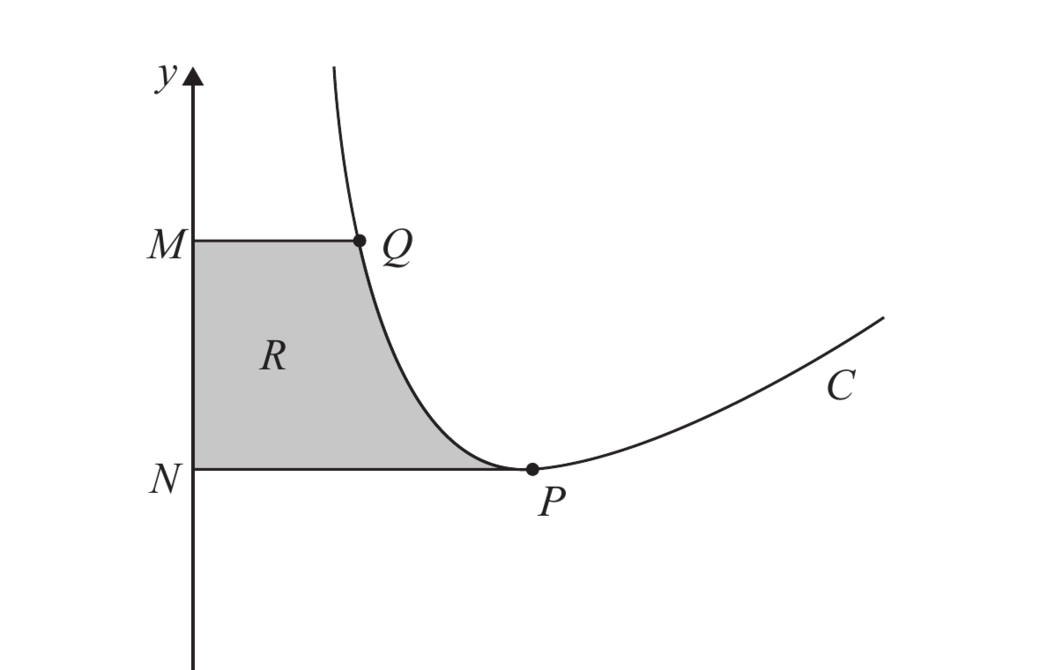
Figure 3
In this question you must show all stages of your working.
Solutions relying entirely on calculator technology are not acceptable.
Figure 3 shows a sketch of the curve C with equation
y=2x+x264−3,x>0
The point P, shown in Figure 3, is the stationary point on C.
(a) Show, using calculus, that the x coordinate of P is 4
(4)
The point Q lies on C and has x coordinate 2
The line segments MQ and NP, shown in Figure 3, are parallel to the x-axis.
The region R, shown shaded in Figure 3, is bounded by C, the y-axis and line segments MQ and NP.
(b) Use algebraic integration to find the exact area of R.
You must make your method clear.
(5)
解答
(a)
解法一
思路
展开
stationary point 要令 dxdy=0。题目要求 show that,所以不能只代 x=4,要从求导和解方程自然推出 x=4。
答题过程
展开
Differentiate
y=2x+64x−2−3.
Then
dxdy=2−128x−3.
At a stationary point,
2−128x−3=2−x3128=2x3=x3=x=00128644.
Therefore, the x coordinate of P is 4.
(b)
解法一
思路
展开
先求 Q 和 P 的高度。区域可以看成:从 x=2 到 x=4 的曲线下面积,减去底部矩形,再加上左边的矩形。
答题过程
展开
At x=2,
y===2(2)+2264−34+16−317.
So Q=(2,17) and M=(0,17).
At x=4,
y===2(4)+4264−38+4−39.
So P=(4,9) and N=(0,9).
Now integrate the curve:
∫(2x+x264−3)dx===∫(2x+64x−2−3)dxx2−64x−1−3xx2−x64−3x.
The area under the curve from x=2 to x=4 is
[x2−x64−3x]24===(16−16−12)−(4−32−6)−12−(−34)22.
The rectangle below y=9 from x=2 to x=4 has area
9(4−2)=18.
The rectangle from x=0 to x=2, between y=9 and y=17, has area
2(17−9)=16.
Therefore,
area of R==22−18+1620.
Hence the exact area of R is 20.
解法二
思路
展开
也可以把右边那块直接看成曲线与直线 y=9 之间的面积,再加左边矩形。这样图形意义更直接。
答题过程
展开
From part (a), P has x coordinate 4.
At x=4,
y=2(4)+4264−3=9.
At x=2,
y=2(2)+2264−3=17.
So the left rectangular part has area
2(17−9)=16.
For 2⩽x⩽4, the lower boundary is the horizontal line y=9.
Therefore the curved part has area
∫24(2x+x264−3−9)dx==∫24(2x+64x−2−12)dx[x2−x64−12x]24.
Evaluate:
[x2−x64−12x]24===(16−16−48)−(4−32−24)−48−(−52)4.
Hence
area of R==4+1620.
Therefore, the exact area of R is 20.