题目
Problem
Figure 2 shows part of the graph with equation y=f(x), where
f(x)=2∣2x−5∣+3x≥0
The vertex of the graph is at point P as shown.
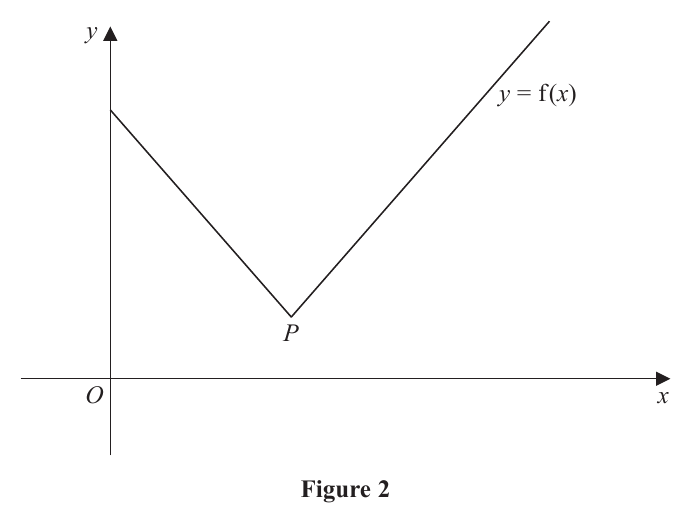
(a) State the coordinates of P.
(2)
(b) Solve the equation f(x)=3x−2.
(4)
Given that the equation
f(x)=kx+2
where k is a constant, has exactly two roots,
(c) find the range of values of k.
(3)
题目中文翻译
图 2 给出了图像 y=f(x) 的一部分,其中
f(x)=2∣2x−5∣+3x≥0
图像的顶点为图中的点 P。
(a) 写出点 P 的坐标。
(b) 解方程 f(x)=3x−2。
已知方程
f(x)=kx+2
其中 k 为常数,且该方程恰有两个根,
(c) 求 k 的取值范围。
解答
(a)
The function is
f(x)=2∣2x−5∣+3
The vertex occurs when the expression inside the absolute value is zero:
2x−5=0
So
x=25
At this value,
f(25)=2∣0∣+3=3
Therefore
P(25,3)
(b)
解法一
思路
展开
按绝对值内的符号拆成两支,分别解方程并检查各自的区间。
答题过程
展开
We need to solve
f(x)=3x−2
That is,
2∣2x−5∣+3=3x−2
Case 1. x≥25
Then
∣2x−5∣=2x−5
So
2(2x−5)+3=3x−2
Hence
4x−7=3x−2
Therefore
x=5
This is valid since 5≥25.
Case 2. 0≤x<25
Then
∣2x−5∣=5−2x
So
2(5−2x)+3=3x−2
Hence
13−4x=3x−2
Therefore
15=7x
so
x=715
This is valid since
0≤715<25
Thus the solutions are
x=715orx=5
解法二
思路
展开
先孤立绝对值再平方,最后回验平方前右边非负的条件。
答题过程
展开
Rearrange to 2∣2x−5∣=3x−5. Any solution must satisfy x≥5/3. Squaring gives
4(2x−5)2=7x2−50x+75=(7x−15)(x−5)=(3x−5)2,0,0.
Both 715 and 5 are at least 35, so the two sides before squaring are non-negative. Thus both satisfy the original equation:
x=715orx=5.
(c)
We need the equation
f(x)=kx+2
to have exactly two roots.
That is,
2∣2x−5∣+3=kx+2
Left branch: 0≤x≤25
On this branch,
f(x)=13−4x
So
13−4x=kx+2
Hence
11=(k+4)x
The case k=−4 would give 11=0, so it yields no solution on this branch. Otherwise,
x=k+411
For this to lie on the left branch, we need
0≤k+411≤25
Since the numerator is positive, this gives
k+4>0
and
k+411≤25
So
22≤5(k+4)
Hence
k≥52
Right branch: x≥25
On this branch,
f(x)=4x−7
So
4x−7=kx+2
Hence
(4−k)x=9
The case k=4 would give 0=9, so it yields no solution on this branch. Otherwise,
x=4−k9
For this to lie on the right branch, we need
4−k9≥25
and also
4−k>0
So
k<4
and
18≥5(4−k)
Hence
k≥52
At k=52, the two branch solutions meet at the vertex, so there is only one root. Therefore, to have exactly two roots,
52<k<4