题目
Problem
The functions f f f g g g
f ( x ) = 4 x + 6 x − 5 x ∈ R , x ≠ 5 f(x)=\frac{4x+6}{x-5}\qquad x\in\mathbb{R},\ x\ne 5 f ( x ) = x − 5 4 x + 6 x ∈ R , x = 5 g ( x ) = 5 − 2 x 2 x ∈ R , x ≤ 0 g(x)=5-2x^2\qquad x\in\mathbb{R},\ x\le 0 g ( x ) = 5 − 2 x 2 x ∈ R , x ≤ 0 (a) Solve the equation
f g ( x ) = 3 fg(x)=3 f g ( x ) = 3 (4)
(b) Find f − 1 f^{-1} f − 1
(3)
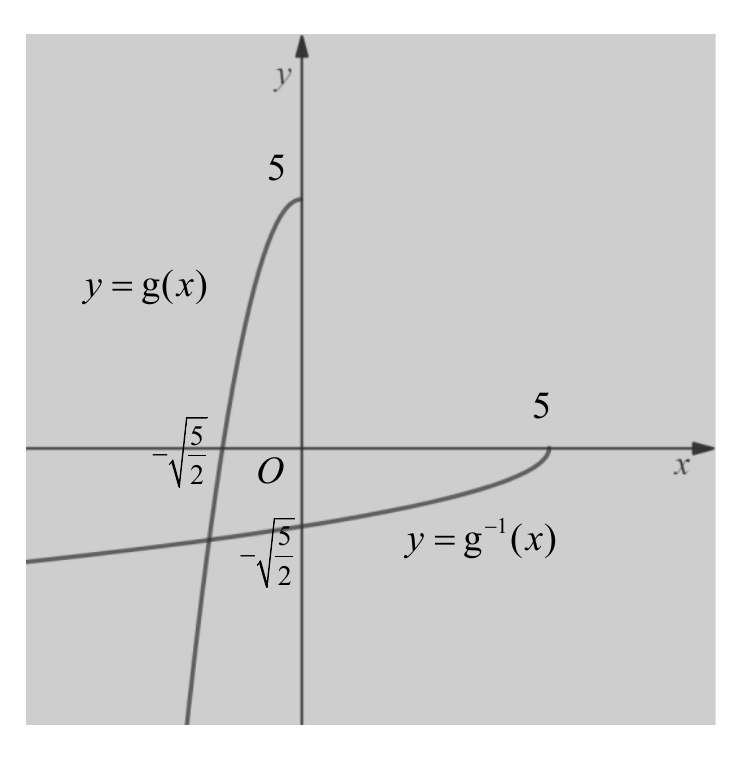
(c) Sketch and label, on the same axes, the curve with equation y = g ( x ) y=g(x) y = g ( x ) y = g − 1 ( x ) y=g^{-1}(x) y = g − 1 ( x )
(3)
题目中文翻译
函数 f f f g g g
f ( x ) = 4 x + 6 x − 5 x ∈ R , x ≠ 5 f(x)=\frac{4x+6}{x-5}\qquad x\in\mathbb{R},\ x\ne 5 f ( x ) = x − 5 4 x + 6 x ∈ R , x = 5 g ( x ) = 5 − 2 x 2 x ∈ R , x ≤ 0 g(x)=5-2x^2\qquad x\in\mathbb{R},\ x\le 0 g ( x ) = 5 − 2 x 2 x ∈ R , x ≤ 0 (a) 解方程
f g ( x ) = 3 fg(x)=3 f g ( x ) = 3 (b) 求 f − 1 f^{-1} f − 1
(c) 在同一坐标轴上画出并标注曲线 y = g ( x ) y=g(x) y = g ( x ) y = g − 1 ( x ) y=g^{-1}(x) y = g − 1 ( x )
解答
(a)
解法一
思路
展开
先直接求复合函数 f ( g ( x ) ) f(g(x)) f ( g ( x )) 3 3 3 g g g x ≤ 0 x\leq0 x ≤ 0
答题过程
展开
Since g ( x ) = 5 − 2 x 2 g(x)=5-2x^2 g ( x ) = 5 − 2 x 2
f ( g ( x ) ) = 4 ( 5 − 2 x 2 ) + 6 ( 5 − 2 x 2 ) − 5 = 26 − 8 x 2 − 2 x 2 . \begin{align*}
f(g(x))
=&\,\frac{4(5-2x^2)+6}{(5-2x^2)-5}\\[2mm]
=&\,\frac{26-8x^2}{-2x^2}.
\end{align*} f ( g ( x )) = = ( 5 − 2 x 2 ) − 5 4 ( 5 − 2 x 2 ) + 6 − 2 x 2 26 − 8 x 2 . Setting f ( g ( x ) ) = 3 f(g(x))=3 f ( g ( x )) = 3
26 − 8 x 2 − 2 x 2 = 3 , 26 − 8 x 2 = − 6 x 2 , x 2 = 13. \begin{align*}
\frac{26-8x^2}{-2x^2}=&\,3,\\[2mm]
26-8x^2=&\,-6x^2,\\[2mm]
x^2=&\,13.
\end{align*} − 2 x 2 26 − 8 x 2 = 26 − 8 x 2 = x 2 = 3 , − 6 x 2 , 13. The domain of g g g x ≤ 0 x\leq0 x ≤ 0
x = − 13 . \boxed{x=-\sqrt{13}}. x = − 13 .
解法二
思路
展开
官方评分资料给出的另一条路线先对 f f f f ( g ( x ) ) = 3 f(g(x))=3 f ( g ( x )) = 3 g ( x ) = f − 1 ( 3 ) g(x)=f^{-1}(3) g ( x ) = f − 1 ( 3 ) g g g
答题过程
展开
Solving f ( u ) = 3 f(u)=3 f ( u ) = 3
4 u + 6 u − 5 = 3 , \frac{4u+6}{u-5}=3, u − 5 4 u + 6 = 3 , so u = − 21 u=-21 u = − 21
f − 1 ( 3 ) = − 21. f^{-1}(3)=-21. f − 1 ( 3 ) = − 21. Therefore g ( x ) = − 21 g(x)=-21 g ( x ) = − 21
5 − 2 x 2 = − 21 , x 2 = 13. \begin{align*}
5-2x^2=&\,-21,\\[2mm]
x^2=&\,13.
\end{align*} 5 − 2 x 2 = x 2 = − 21 , 13. Since the domain of g g g x ≤ 0 x\leq0 x ≤ 0
x = − 13 . \boxed{x=-\sqrt{13}}. x = − 13 .
(b)
解法一
思路
展开
令 y = f ( x ) y=f(x) y = f ( x ) x x x y y y 4 4 4 x ≠ 4 x\ne4 x = 4
答题过程
展开
Let
y = 4 x + 6 x − 5 . y=\frac{4x+6}{x-5}. y = x − 5 4 x + 6 . Then
y ( x − 5 ) = 4 x + 6 , y x − 4 x = 5 y + 6 , x ( y − 4 ) = 5 y + 6 , x = 5 y + 6 y − 4 . \begin{align*}
y(x-5)=&\,4x+6,\\[2mm]
yx-4x=&\,5y+6,\\[2mm]
x(y-4)=&\,5y+6,\\[2mm]
x=&\,\frac{5y+6}{y-4}.
\end{align*} y ( x − 5 ) = y x − 4 x = x ( y − 4 ) = x = 4 x + 6 , 5 y + 6 , 5 y + 6 , y − 4 5 y + 6 . Therefore
f − 1 ( x ) = 5 x + 6 x − 4 , \boxed{f^{-1}(x)=\frac{5x+6}{x-4}}, f − 1 ( x ) = x − 4 5 x + 6 , with domain
x ∈ R , x ≠ 4 . \boxed{x\in\mathbb{R},\quad x\ne4}. x ∈ R , x = 4 .
(c)
解法一
思路
展开
先找出受限函数 g g g y = x y=x y = x g − 1 g^{-1} g − 1
答题过程
展开
For
g ( x ) = 5 − 2 x 2 , x ≤ 0 , g(x)=5-2x^2,\qquad x\leq0, g ( x ) = 5 − 2 x 2 , x ≤ 0 , the graph is the left half of a downward-opening parabola. Its y y y ( 0 , 5 ) (0,5) ( 0 , 5 )
For the x x x
5 − 2 x 2 = 0 , 5-2x^2=0, 5 − 2 x 2 = 0 , so, using x ≤ 0 x\leq0 x ≤ 0
x = − 5 2 . x=-\sqrt{\frac52}. x = − 2 5 . Thus the x x x
( − 5 2 , 0 ) . \left(-\sqrt{\frac52},0\right). ( − 2 5 , 0 ) . The graph of y = g − 1 ( x ) y=g^{-1}(x) y = g − 1 ( x ) y = g ( x ) y=g(x) y = g ( x ) y = x y=x y = x
( 5 , 0 ) and ( 0 , − 5 2 ) . (5,0)
\quad\text{and}\quad
\left(0,-\sqrt{\frac52}\right). ( 5 , 0 ) and ( 0 , − 2 5 ) .