题目
Problem
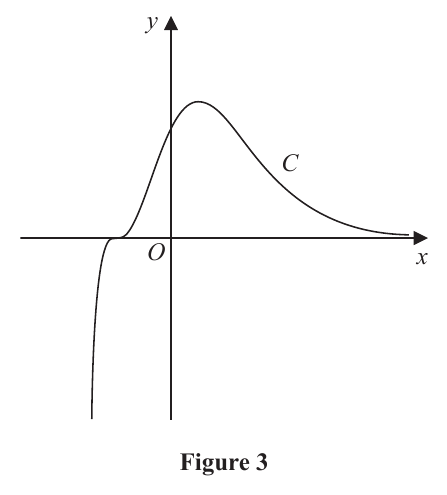
Figure 3 shows a sketch of the curve C with equation y=f(x), where
f(x)=(2x+1)3e−4x
(a) Show that
f′(x)=A(2x+1)2(1−4x)e−4x
where A is a constant to be found.
(4)
(b) Hence find the exact coordinates of the two stationary points on C.
(3)
The function g is defined by
g(x)=8f(x−2)
(c) Find the coordinates of the maximum stationary point on the curve with equation y=g(x).
(2)
题目中文翻译
图 3 给出了曲线 C 的示意图,其方程为 y=f(x),其中
f(x)=(2x+1)3e−4x
(a) 证明
f′(x)=A(2x+1)2(1−4x)e−4x
其中 A 是需要求出的常数。
(b) 由此求曲线 C 上两个驻点的精确坐标。
函数 g 定义为
g(x)=8f(x−2)
(c) 求曲线 y=g(x) 上极大驻点的坐标。
解答
(a)
解法一
思路
展开
f(x) 是两个函数的乘积:(2x+1)3 和 e−4x,所以用乘积法则求导。求导后把共同因子 (2x+1)2e−4x 提出来,再整理成题目给出的形式。
答题过程
展开
We have
f(x)=(2x+1)3e−4x.
Using the product rule,
f′(x)===6(2x+1)2e−4x−4(2x+1)3e−4x2(2x+1)2e−4x(3−2(2x+1))2(2x+1)2e−4x(1−4x).
Therefore
f′(x)=A(2x+1)2(1−4x)e−4x,
where
A=2.
(b)
解法一
思路
展开
驻点满足 f′(x)=0。由于 e−4x 永远不为 0,所以只需要令代数因子为 0。求出两个 x 值后,代回原函数得到对应的 y 坐标。
答题过程
展开
Stationary points occur when
f′(x)=0.
From part (a),
2(2x+1)2(1−4x)e−4x=0.
Since 2=0 and e−4x=0,
(2x+1)2(1−4x)=0.
So
2x+1=0or1−4x=0.
Hence
x=−21orx=41.
When x=−21,
f(−21)=03e2=0.
When x=41,
f(41)===(2⋅41+1)3e−1(23)3e18e27.
Therefore the two stationary points are
(−21,0)and(41,8e27).
(c)
解法一
思路
展开
g(x)=8f(x−2) 表示把 y=f(x) 向右平移 2 个单位,再把 y 坐标乘以 8。原曲线的极大驻点是 (41,8e27),所以直接变换这个点。
答题过程
展开
The maximum stationary point on y=f(x) is
(41,8e27).
The function
g(x)=8f(x−2)
shifts the graph of y=f(x) 2 units to the right and multiplies all y-coordinates by 8.
So the x-coordinate becomes
41+2=49,
and the y-coordinate becomes
8⋅8e27=e27.
Therefore the maximum stationary point on y=g(x) is
(49,e27).