题目
Problem
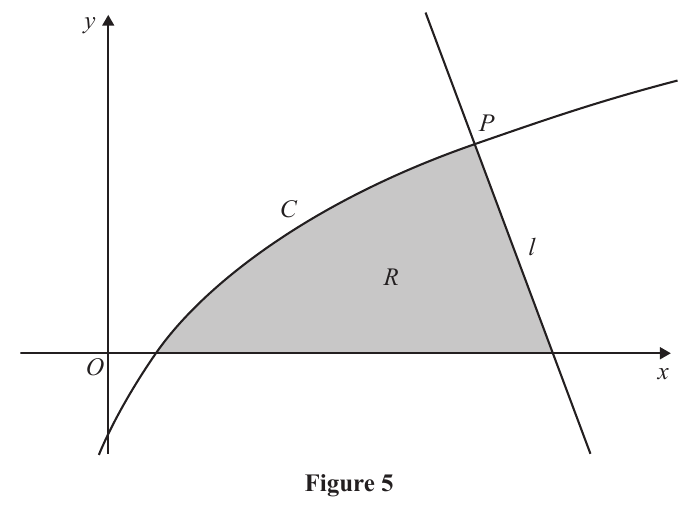
Figure 5 shows a sketch of part of the curve C with equation y=f(x) where
f(x)=2x+16x2+4x−2x>−21
(a) Find f′(x), giving the answer in simplest form.
(3)
The line l is the normal to C at the point P(2,6)
(b) Show that an equation for l is
16y+5x=106
(3)
(c) Write f(x) in the form Ax+B+2x+1D where A, B and D are constants.
(3)
The region R, shown shaded in Figure 5, is bounded by C, l and the x-axis.
(d) Use algebraic integration to find the exact area of R, giving your answer in the form P+Qln3, where P and Q are rational constants.
(Solutions based entirely on calculator technology are not acceptable.)
(5)
题目中文翻译
图 5 给出了曲线 C 的一部分草图,其方程为 y=f(x),其中
f(x)=2x+16x2+4x−2x>−21
(a) 求 f′(x),并把答案写成最简形式。
直线 l 是曲线 C 在点 P(2,6) 处的法线。
(b) 证明直线 l 的方程为
16y+5x=106
(c) 将 f(x) 写成 Ax+B+2x+1D 的形式,其中 A、B 和 D 是常数。
图 5 中阴影部分区域 R 由 C、l 和 x 轴围成。
(d) 用代数积分求 R 的精确面积,并将答案写成 P+Qln3 的形式,其中 P 和 Q 是有理常数。
(不接受完全依赖计算器技术的解法。)
解答
(a)
解法一
思路
展开
对分式使用商法则,注意分母的导数为 2。随后展开并合并分子中的同类项,得到最简形式。
答题过程
展开
Using the quotient rule,
f′(x)==(2x+1)2(2x+1)(12x+4)−(2x+1)22(6x2+4x−2)(2x+1)212x2+12x+8.
Therefore,
f′(x)=(2x+1)212x2+12x+8.
(b)
解法一
思路
展开
先把 x=2 代入 (a) 的导数,得到点 P 处切线斜率;法线斜率是它的负倒数。再用点斜式写出法线,并整理成题目指定的形式。
答题过程
展开
At x=2,
f′(2)==(2(2)+1)212(2)2+12(2)+82580=516.
Therefore, the gradient of the normal is −165. Since it passes through P(2,6),
y−6=−165(x−2).
Hence,
16y−96=16y+5x=−5x+10,106.
Thus, an equation of l is
16y+5x=106.
(c)
解法一
思路
展开
使用多项式除法,先确定商的一次项 3x,再确定常数项 21,最后把余数写在原分母 2x+1 上。
答题过程
展开
We seek constants A, B and D such that
6x2+4x−2=(Ax+B)(2x+1)+D.
Expanding the right-hand side,
(Ax+B)(2x+1)+D=2Ax2+(A+2B)x+B+D.
Comparing coefficients gives
2A=6,
so A=3. Also,
A+2B=4,
so B=21. Finally,
B+D=−2,
so D=−25.
Therefore,
f(x)=3x+21−2(2x+1)5.
(d)
解法一
思路
展开
先找区域的三个关键点:曲线与 x 轴交于 x=31,曲线与法线在 P 处相交,而法线与 x 轴交于 x=5106。区域面积等于从 31 到 2 的曲线下方面积,加上从 2 到 5106 的法线下方三角形面积。
答题过程
展开
The curve meets the x-axis when
6x2+4x−2=0.
Factorising,
2(3x−1)(x+1)=0.
Since x>−21, the relevant root is
x=31.
The line l meets the x-axis when y=0, so
x=5106.
Using the result from part (c),
∫f(x)dx==∫(3x+21−2(2x+1)5)dx23x2+21x−45ln(2x+1).
Thus the area under the curve from x=31 to x=2 is
AC===[23x2+21x−45ln(2x+1)]312(7−45ln5)−(31−45ln35)320−45ln3.
The remaining part is a triangle with height 6 and base
5106−2=596.
Therefore, its area is
AT=21(596)(6)=5288.
Hence,
Area(R)===AC+AT320+5288−45ln315964−45ln3.