
题目
Figure 3 shows a sketch of part of the graph with equation , where
and is a positive constant.
The graph
- cuts the -axis at the point
- has a vertex at the point
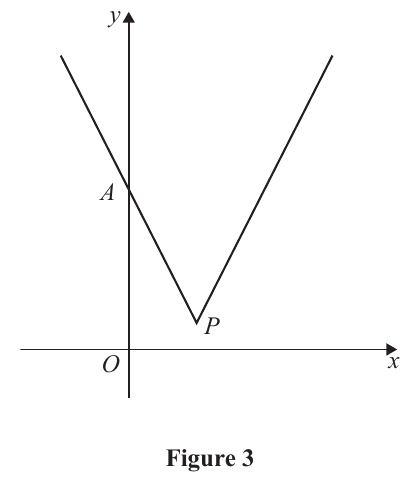
(a) Find, in simplest form in terms of ,
(i) the coordinate of
(ii) the coordinates of
(b) Find, in terms of , the range of values of which satisfy
Given that the line with equation intersects the graph of at 2 distinct points,
(c) find the range of values of .
题目中文翻译
图 3 给出了图像 的部分草图,其中
且 为正常数。
该图像
- 与 轴交于点
- 顶点为点
(a) 用 的最简形式表示:
(i) 点 的 坐标;
(ii) 点 的坐标。
(b) 用 表示满足
的 的取值范围。
已知直线 与图像 有两个不同交点,
(c) 求 的取值范围。
解答
(a)
(i)
At the -axis,
So
Therefore the coordinate of is
(ii)
The vertex occurs when the expression inside the modulus is zero:
Since ,
At the vertex,
Therefore
(b)
We need to solve
So
Since , this gives two cases.
First,
so
and therefore
Second,
so
and therefore
Hence
(c)
The graph has two branches:
on the left of the vertex, and
on the right of the vertex.
For the line
to intersect the right-hand branch, the right-hand branch must have gradient greater than .
So
This gives the lower bound.
For the upper bound, consider the case where the line just passes through the vertex. Then the two intersections merge into one point.
At the vertex,
Substitute this into
to find the boundary value:
Multiply by :
So
Factorise:
Since is positive,
At , the line passes through the vertex, so there is only one intersection at the vertex rather than two distinct points. Therefore we need
Combining the two conditions,