题目
Problem
Figure 3
A colony of bees is being studied. The number of bees in the colony is modelled by
the equation
P=200−15+e0.8t160e0.6tt∈R,t≥0
where P is the number of bees, measured in thousands, t years after the study started.
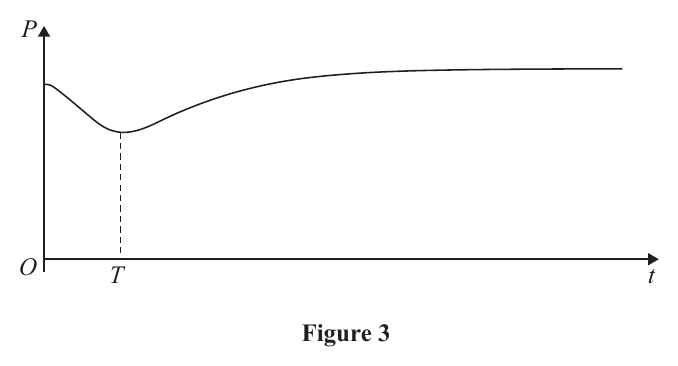
A sketch of the graph of P against t is shown in Figure 3
(a) Calculate the number of bees in the colony at the start of the study.
(2)
(b) Find dtdP
(3)
The population of bees initially decreases, reaching a minimum value after T years, as
shown in Figure 3.
(c) Using your answer to part (b), calculate the value of T to 2 decimal places.
Solutions relying entirely on calculator technology are not acceptable.
(4)
题目中文翻译
图 3。
正在研究一个蜜蜂群落。群落中的蜜蜂数量由下式建模:
P=200−15+e0.8t160e0.6tt∈R,t≥0
其中 P 以千只计,t 为研究开始后经过的年数。
图 3 给出了 P 随 t 变化的图像草图。
(a) 计算研究开始时群落中的蜜蜂数量。
(b) 求 dtdP。
蜜蜂数量开始时下降,并如图 3 所示,在 T 年后达到最小值。
(c) 利用 (b) 的答案,求 T 的值,精确到小数点后 2 位。
(不接受完全依赖计算器技术的解法。)
解答
(a)
解法一
思路
展开
研究开始时 t=0。把 t=0 代入模型,并用 e0=1 求出 P;由于 P 的单位是千只,最后要换算成实际只数。
答题过程
展开
At the start of the study, t=0. Therefore,
P===200−15+e0160e0200−16160190.
Since P is measured in thousands, the number of bees is
190×1000=190000.
(b)
解法一
思路
展开
对分式使用商法则,并在过程中分别求 160e0.6t 与 15+e0.8t 的导数。最后合并指数项,可得到便于 (c) 使用的形式。
答题过程
展开
Let
u=160e0.6tandv=15+e0.8t.
Then
u′=96e0.6tandv′=0.8e0.8t.
Using the quotient rule,
dtdP===−v2vu′−uv′−(15+e0.8t)2(15+e0.8t)96e0.6t+(15+e0.8t)2160e0.6t⋅0.8e0.8t(15+e0.8t)232e1.4t−1440e0.6t.
Hence
dtdP=(15+e0.8t)232e1.4t−1440e0.6t.
解法二
思路
展开
官方评分资料也接受把分式写成乘积,再使用乘积法则与链式法则。这条路线避开了直接套用商法则,化简后得到同一个导数。
答题过程
展开
Rewrite the model as
P=200−160e0.6t(15+e0.8t)−1.
Using the product rule and the chain rule,
dtdP=−96e0.6t(15+e0.8t)−1+128e1.4t(15+e0.8t)−2.
Writing both terms over a common denominator,
dtdP==(15+e0.8t)2−96e0.6t(15+e0.8t)+(15+e0.8t)2128e1.4t(15+e0.8t)232e1.4t−1440e0.6t.
Therefore,
dtdP=(15+e0.8t)232e1.4t−1440e0.6t.
(c)
解法一
思路
展开
由题意,t=T 时数量达到最小值,因此令 (b) 中的导数等于 0。分母恒为正,所以只需令分子为 0;整理指数方程后取自然对数即可求出 T。
答题过程
展开
At the minimum point,
dtdP=0.
Since (15+e0.8t)2>0, the numerator must be zero:
32e1.4T−1440e0.6T=32e1.4T=e0.8T=01440e0.6T45.
Taking natural logarithms,
0.8T=T==ln450.8ln454.758…
Therefore, to 2 decimal places,
T=4.76 years.