题目
Problem
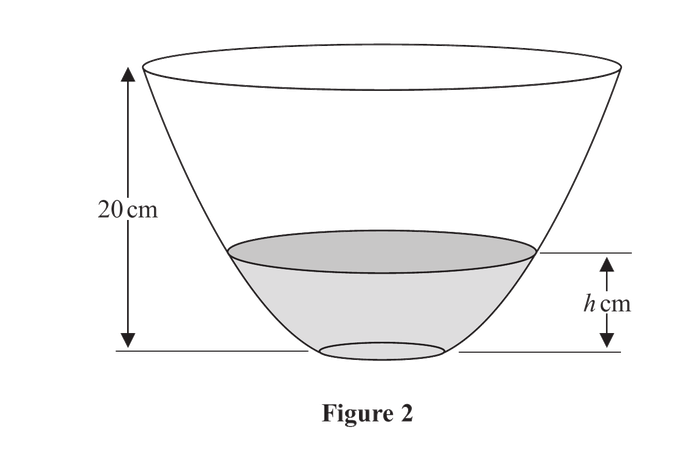
A bowl with circular cross section and height 20 cm is shown in Figure 2.
The bowl is initially empty and water starts flowing into the bowl.
When the depth of water is h cm, the volume of water in the bowl, V cm3, is modelled by the equation
V=31h2(h+4)0≤h≤20
Given that the water flows into the bowl at a constant rate of 160 cm3 s−1, find, according to the model,
(a) the time taken to fill the bowl,
(2)
(b) the rate of change of the depth of the water, in cm s−1, when h=5
(5)
题目中文翻译
图 2 显示了一个圆形横截面、高度为 20 cm 的碗。
该碗最初是空的,水开始流入碗中。
当水深为 h cm 时,碗中水的体积 V cm3 可由下式建模:
V=31h2(h+4)0≤h≤20
已知水以恒定速率 160 cm3 s−1 流入碗中,求根据该模型:
(a) 装满碗所需的时间;
(b) 当 h=5 时,水深的变化率,单位 cm s−1。
解答
(a)
解法一
思路
展开
碗装满时水深为 20 cm。先把 h=20 代入体积模型求出总容量,再除以恒定的流入速率,即可得到装满所需时间。
答题过程
展开
When the bowl is full, h=20. Therefore,
V==31(20)2(20+4)3200 cm3.
Since the water flows in at 160 cm3 s−1, the time taken is
1603200=20 s.
(b)
解法一
思路
展开
体积 V 是水深 h 的函数,而 h 随时间 t 变化。先对体积公式关于 h 求导,再用链式法则 dtdV=dhdVdtdh,代入已知流量和 h=5 求水深变化率。
答题过程
展开
First,
V=31h3+34h2,
so
dhdV=h2+38h.
By the chain rule,
dtdV=dhdV×dtdh.
When h=5 and dtdV=160,
160==(52+38(5))×dtdh3115dtdh.
Therefore,
dtdh=2396 cm s−1
(approximately 4.17 cm s−1).