Skip to content
CalcGospel 國際數學圖譜
返回

P4 2022 Jan Q4

A Level / Edexcel / P4

IAL 2022 Jan Paper · Question 4

题目

Problem

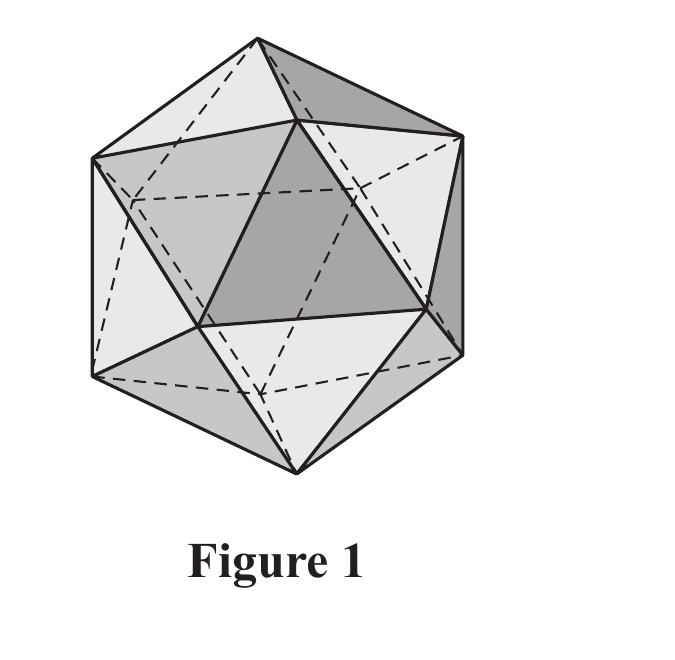
A regular icosahedron of side length xx cm, shown in Figure 1, is expanding uniformly.

The icosahedron consists of 20 congruent equilateral triangular faces of side length xx cm.

(a) Show that the surface area, AA cm2^2, of the icosahedron is given by

A=53x2A=5\sqrt{3}x^2
(2)

Given that the volume, VV cm3^3, of the icosahedron is given by

V=512(3+5)x3V=\frac{5}{12}\big(3+\sqrt{5}\big)x^3

(b) show that

dVdA=(3+5)x83\frac{\mathrm{d}V}{\mathrm{d}A}=\frac{(3+\sqrt{5})x}{8\sqrt{3}}
(3)

The surface area of the icosahedron is increasing at a constant rate of 0.0250.025 cm2^2s−1^{-1}

(c) Find the rate of change of the volume of the icosahedron when x=2x=2, giving your answer to 2 significant figures.

(3)
题目中文翻译

图 1 所示为一个边长为 xx cm 的正二十面体,它正在均匀地膨胀。

该正二十面体由 20 个全等的正三角形面组成,每个面的边长都是 xx cm。

(a) 证明该正二十面体的表面积 AA cm2^2 为

A=53x2A=5\sqrt{3}x^2
(2)

已知该正二十面体的体积 VV cm3^3 为

V=512(3+5)x3V=\frac{5}{12}\big(3+\sqrt{5}\big)x^3

(b) 证明

dVdA=(3+5)x83\frac{\mathrm{d}V}{\mathrm{d}A}=\frac{(3+\sqrt{5})x}{8\sqrt{3}}
(3)

该正二十面体的表面积正以恒定速率 0.0250.025 cm2^2s−1^{-1} 增加。

(c) 当 x=2x=2 时,求该正二十面体体积的变化率,答案保留 2 位有效数字。

(3)

解答

(a)

解法一

思路

展开

每个面都是边长为 xx 的正三角形。先用 12absin⁡C\frac12ab\sin C 求一个面的面积,再乘以 2020。

答题过程

展开

The area of one equilateral triangular face is

12x2sin⁡60∘= 12x2(32)= 34x2.\begin{align*} \frac12x^2\sin60^\circ =&\,\frac12x^2\bigg(\frac{\sqrt3}{2}\bigg)\\ =&\,\frac{\sqrt3}{4}x^2. \end{align*}

Since the icosahedron has 2020 congruent faces,

A= 20(34x2)= 53x2,\begin{align*} A =&\,20\bigg(\frac{\sqrt3}{4}x^2\bigg)\\ =&\,\boxed{5\sqrt3x^2}, \end{align*}

as required.

也可以先求正三角形的高 hh。高平分底边,由勾股定理,

h= x2−(x2)2= 32x.\begin{align*} h=&\,\sqrt{x^2-\bigg(\frac{x}{2}\bigg)^2}\\ =&\,\frac{\sqrt3}{2}x. \end{align*}

一个面的面积仍为

12xh= 12x(32x)= 34x2.\begin{align*} \frac12xh=&\,\frac12x\bigg(\frac{\sqrt3}{2}x\bigg)\\ =&\,\frac{\sqrt3}{4}x^2. \end{align*}

将它乘以 2020,同样得到 A=53x2A=5\sqrt3x^2。

(b)

解法一

思路

展开

分别把表面积 AA 和体积 VV 关于边长 xx 求导,再使用 dVdA=dV/dxdA/dx\frac{\mathrm{d}V}{\mathrm{d}A}=\frac{\mathrm{d}V/\mathrm{d}x}{\mathrm{d}A/\mathrm{d}x},最后化简根式系数。

答题过程

展开

Differentiating with respect to xx gives

dAdx=103x\frac{\mathrm{d}A}{\mathrm{d}x}=10\sqrt3x

and

dVdx=54(3+5)x2.\frac{\mathrm{d}V}{\mathrm{d}x} =\frac54(3+\sqrt5)x^2.

Therefore,

dVdA= dV/dxdA/dx= 54(3+5)x2103x= (3+5)x83,\begin{align*} \frac{\mathrm{d}V}{\mathrm{d}A} =&\, \frac{\mathrm{d}V/\mathrm{d}x} {\mathrm{d}A/\mathrm{d}x}\\ =&\,\frac{ \frac54(3+\sqrt5)x^2 }{10\sqrt3x}\\ =&\,\boxed{ \frac{(3+\sqrt5)x}{8\sqrt3} }, \end{align*}

as required.

解法二

思路

展开

由 (a) 把边长 xx 表示成表面积 AA 的函数,代入体积公式,使 VV 只含 AA。直接关于 AA 求导后,再用 A/(53)=x\sqrt{A/(5\sqrt3)}=x 写回题目要求的形式;求导时要保留内层 A/(53)A/(5\sqrt3) 的导数。

答题过程

展开

Since x>0x>0, part (a) gives

x=(A53)12.x=\bigg(\frac{A}{5\sqrt3}\bigg)^{\frac12}.

Substituting into the volume formula,

V=512(3+5)(A53)32.V=\frac5{12}(3+\sqrt5) \bigg(\frac{A}{5\sqrt3}\bigg)^{\frac32}.

Differentiating with respect to AA,

 dVdA= 512(3+5)32 ×(A53)12153= 3+583(A53)12.\begin{align*} &\,\frac{\mathrm{d}V}{\mathrm{d}A}\\ =&\,\frac5{12}(3+\sqrt5)\frac32\\ &\,\hspace{2pt}\times \bigg(\frac{A}{5\sqrt3}\bigg)^{\frac12} \frac1{5\sqrt3}\\ =&\,\frac{3+\sqrt5}{8\sqrt3} \bigg(\frac{A}{5\sqrt3}\bigg)^{\frac12}. \end{align*}

Using (A/(53))1/2=x\big(A/(5\sqrt3)\big)^{1/2}=x,

dVdA=(3+5)x83,\boxed{\frac{\mathrm{d}V}{\mathrm{d}A} =\frac{(3+\sqrt5)x}{8\sqrt3}},

as required.

(c)

解法一

思路

展开

承接 (b),用链式法则 dVdt=dVdAdAdt\frac{\mathrm{d}V}{\mathrm{d}t}=\frac{\mathrm{d}V}{\mathrm{d}A}\frac{\mathrm{d}A}{\mathrm{d}t}。代入已知表面积增长率及 x=2x=2,再按要求取两位有效数字。

答题过程

展开

The surface area is increasing at the rate

dAdt=0.025 cm2 s−1.\frac{\mathrm{d}A}{\mathrm{d}t} =0.025\mathrm{\ cm^2\,s^{-1}}.

Using the result from part (b),

dVdt= dVdAdAdt= (3+5)x83(0.025).\begin{align*} \frac{\mathrm{d}V}{\mathrm{d}t} =&\, \frac{\mathrm{d}V}{\mathrm{d}A} \frac{\mathrm{d}A}{\mathrm{d}t}\\ =&\,\frac{(3+\sqrt5)x}{8\sqrt3}(0.025). \end{align*}

When x=2x=2,

dVdt= 2(3+5)83(0.025)= 0.01889…\begin{align*} \frac{\mathrm{d}V}{\mathrm{d}t} =&\,\frac{2(3+\sqrt5)}{8\sqrt3}(0.025)\\ =&\,0.01889\ldots \end{align*}

Therefore, to two significant figures,

dVdt=0.019 cm3 s−1.\boxed{ \frac{\mathrm{d}V}{\mathrm{d}t} =0.019\mathrm{\ cm^3\,s^{-1}} }.