题目
Problem
A tablet is dissolving in water.
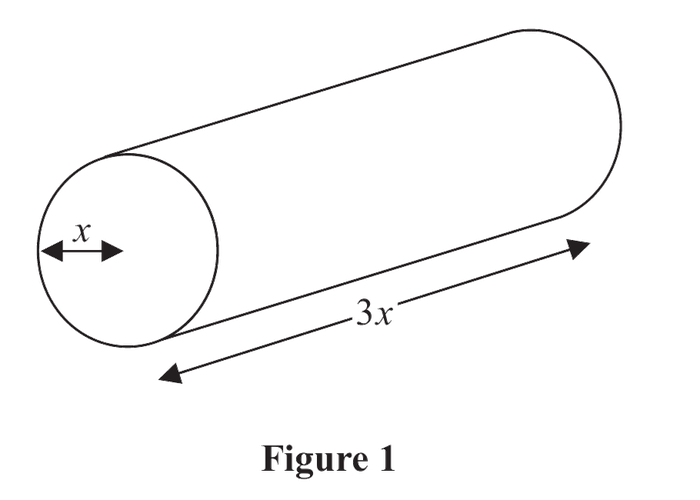
The tablet is modelled as a cylinder, shown in Figure 1.
At t seconds after the tablet is dropped into the water, the radius of the tablet is x mm and the length of the tablet is 3x mm.
The cross-sectional area of the tablet is decreasing at a constant rate of 0.5 mm2 s−1
(a) Find
dtdx
when x=7
(4)
(b) Find, according to the model, the rate of decrease of the volume of the tablet when x=4
(4)
题目中文翻译
一片药片正在水中溶解。
药片被建模为一个圆柱体,如图 1 所示。
药片投入水中 t 秒后,药片半径为 x mm,长度为 3x mm。
药片横截面积正以恒定速率 0.5 mm2 s−1 减小。
(a) 当 x=7 时,求
dtdx
。
(b) 当 x=4 时,根据该模型求药片体积的减小速率。
解答
(a)
解法一
思路
展开
横截面是半径为 x 的圆,所以面积为 A=πx2。把已知的面积减小速率写成 dtdA=−0.5,再利用链式法则求 dtdx。
答题过程
展开
The cross-sectional area is
A=πx2.
Since the area is decreasing at 0.5 mm2 s−1,
dtdA=−0.5.
Also,
dxdA=2πx.
Using the chain rule,
dtdx===dA/dxdA/dt2πx−0.5−4πx1.
When x=7,
dtdx==−28π1−0.011368…
Therefore,
dtdx=−0.0114 mms−1
to three significant figures.
(b)
解法一
思路
展开
圆柱体长度为 3x,所以先把体积写成只含 x 的函数。再将 dxdV 与 (a) 中得到的通式 dtdx=−4πx1 相乘;最后把负的体积变化率转换为正的“减小速率”。
答题过程
展开
The volume of the cylindrical tablet is
V==πx2(3x)3πx3.
Hence
dxdV=9πx2.
Using the general expression for dtdx from part (a),
dtdV===dxdVdtdx(9πx2)(−4πx1)−49x.
When x=4,
dtdV=−9 mm3s−1.
Therefore, the rate of decrease of the volume is
9 mm3s−1.