题目
Problem
A spherical ball of ice of radius 12 cm is placed in a bucket of water.
In a model of the situation,
- the ball remains spherical as it melts
- t minutes after the ball of ice is placed in the bucket, its radius is r cm
- the rate of decrease of the radius of the ball of ice is inversely proportional to the square of the radius
- the radius of the ball of ice is 6 cm after 15 minutes
Using the model and the information given,
(a) find an equation linking r and t,
(5)
(b) find the time taken for the ball of ice to melt completely.
(2)
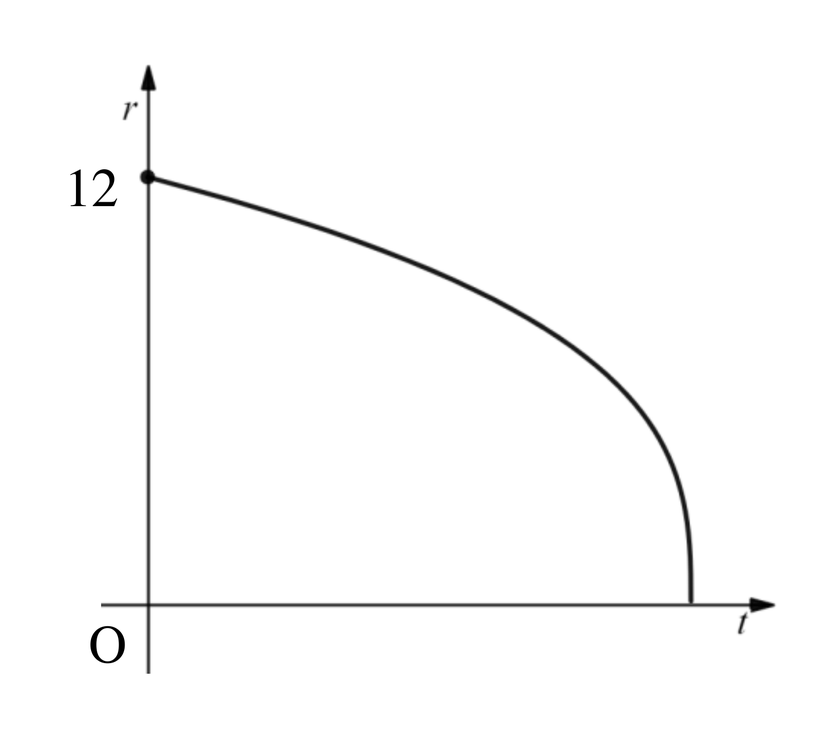
(c) On Diagram 1 on page 27, sketch a graph of r against t.

(1)
题目中文翻译
一个半径为 12 cm 的球形冰球被放入一桶水中。
在该情境的模型中:
- 冰球融化时始终保持球形
- 冰球放入桶中后 t 分钟时,它的半径为 r cm
- 冰球半径的减小速率与半径平方成反比
- 15 分钟后冰球半径为 6 cm
利用该模型和所给信息,
(a) 求联系 r 与 t 的方程;
(5)
(b) 求冰球完全融化所需的时间;
(2)
(c) 在第 27 页的 Diagram 1 上,画出 r 关于 t 的图像草图。
(1)
解答
(a)
解法一
思路
展开
“半径的减小速率与半径平方成反比”表示 dtdr=−r2k,其中 k>0。分离变量并积分后,先用初始半径 12 求积分常数,再用 t=15 时 r=6 求比例常数。
答题过程
展开
Since the radius is decreasing at a rate inversely proportional to r2,
dtdr=−r2k,
where k>0.
Separating the variables,
r2dr=−kdt.
Integrating,
31r3=−kt+C.
When t=0, r=12, so
C=31(123)=576.
When t=15, r=6, so
31(63)=72=15k=k=−15k+576,−15k+576,504,5168.
Therefore,
31r3=−5168t+576.
An equation linking r and t is
r3=1728−5504t.
解法二:体积的变化率
思路
展开
球的体积为 V=34πr3。用链式法则把体积变化率与半径变化率联系起来,r2 因子恰好约去,因此体积按常速减少。利用两个时刻的体积求出线性关系,再代回球体积公式,得到 r 与 t 的方程。
答题过程
展开
Let V be the volume of the ball, in cm3. Then
V=34πr3.
Since dtdr=−r2k with k>0, the chain rule gives
dtdV===drdVdtdr4πr2(−r2k)−4πk.
Thus the volume decreases at a constant rate. Writing β=4πk>0 and integrating,
V=−βt+C.
At t=0, r=12, so
C==34π(123)2304π.
At t=15, r=6, so
V=34π(63)=288π.
Therefore,
288π=15β=β=−15β+2304π,2016π,5672π.
Hence
V=2304π−5672πt.
Substituting V=34πr3 gives
34πr3=2304π−5672πt.
Dividing by 34π,
r3=1728−5504t.
(b)
解法一
思路
展开
冰球完全融化时半径为 0。令 (a) 中的 r=0,即可求出对应时间,并按题目语境保留分钟单位。
答题过程
展开
When the ball has melted completely, r=0. Hence
0=1728−5504t.
Therefore,
t===5041728×5712017.1…
Thus the time taken is
7120 minutes.
This is approximately 17.1 minutes.
Using the volume equation from (a), complete melting also corresponds to V=0, so
0=t==2304π−5672πt,6722304×57120 minutes.
(c)
解法一
思路
展开
由 (a) 可写成 r=(1728−5504t)1/3。图像从 (0,12) 开始,在第一象限内下降;由于 dtdr=−r2k,随着 r 变小,斜率的绝对值越来越大,所以曲线越来越陡,并在 (7120,0) 结束。
答题过程
展开
The graph:
- starts at (0,12);
- decreases entirely within the first quadrant;
- becomes progressively steeper as r decreases;
- meets the t-axis at (7120,0).