Skip to content
CalcGospel 國際數學圖譜
返回

P4 2023 Jan Q8

A Level / Edexcel / P4

IAL 2023 Jan Paper · Question 8

题目

Problem

In this question you must show all stages of your working.

Solutions relying entirely on calculator technology are not acceptable.

A curve CC has parametric equations

x= sin⁡2t,y= 2tan⁡t,0≤t<π2.\begin{align*} x=&\,\sin^2t,\\ y=&\,2\tan t,\\[4mm] &0\le t<\frac{\pi}{2}. \end{align*}

The point PP with parameter t=π4t=\dfrac{\pi}{4} lies on CC.

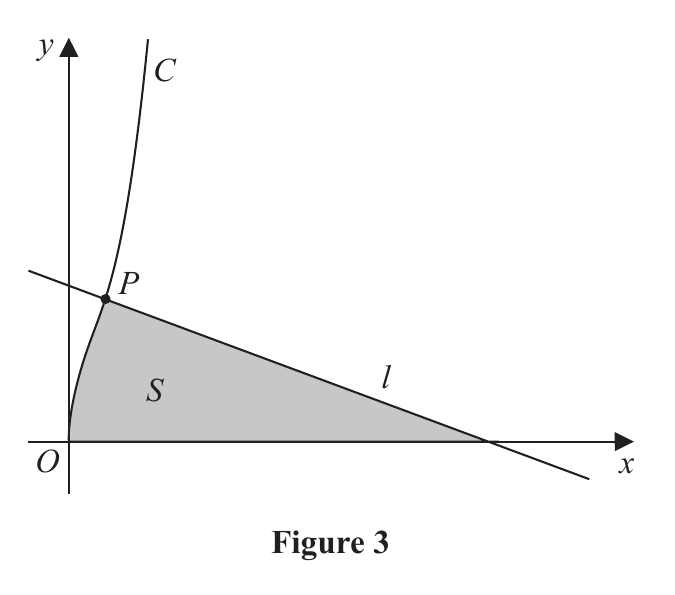
The line ll is the normal to CC at PP, as shown in Figure 3.

(a) Show, using calculus, that an equation for ll is

8y+2x=178y+2x=17
(5)

The region SS, shown shaded in Figure 3, is bounded by CC, ll and the xx-axis.

(b) Find, using calculus, the exact area of SS.

(6)
题目中文翻译

本题中你必须写出解题过程的所有步骤。

完全依赖计算器技术的解法不被接受。

曲线 CC 的参数方程为

x= sin⁡2t,y= 2tan⁡t,0≤t<π2.\begin{align*} x=&\,\sin^2t,\\ y=&\,2\tan t,\\[4mm] &0\le t<\frac{\pi}{2}. \end{align*}

参数为 t=π4t=\dfrac{\pi}{4} 的点 PP 在曲线 CC 上。

如图 3 所示,直线 ll 是曲线 CC 在点 PP 处的法线。

(a) 用微积分证明,直线 ll 的一个方程为以下等式:

8y+2x=178y+2x=17
(5)

图 3 中阴影所示区域 SS 由 CC、ll 以及 xx 轴围成。

(b) 用微积分求 SS 的精确面积。

(6)

解答

(a)

解法一

思路

展开

先把 t=π4t=\frac{\pi}{4} 代入参数方程求出点 PP。然后分别求 dxdt\frac{\mathrm{d}x}{\mathrm{d}t} 和 dydt\frac{\mathrm{d}y}{\mathrm{d}t},由参数方程的求导公式得到切线斜率;法线斜率是其负倒数,最后用点斜式整理成题目要求的方程。

答题过程

展开

At t=π4t=\frac{\pi}{4},

x=sin⁡2π4=12x=\sin^2\frac{\pi}{4}=\frac{1}{2}

and

y=2tan⁡π4=2.y=2\tan\frac{\pi}{4}=2.

Therefore,

P=(12,2).P=\bigg(\frac{1}{2},2\bigg).

Differentiating the parametric equations,

dxdt=2sin⁡tcos⁡t=sin⁡2t\frac{\mathrm{d}x}{\mathrm{d}t} =2\sin t\cos t =\sin2t

and

dydt=2sec⁡2t.\frac{\mathrm{d}y}{\mathrm{d}t} =2\sec^2t.

Hence

dydx= dydt÷dxdt= 2sec⁡2t2sin⁡tcos⁡t.\begin{align*} \frac{\mathrm{d}y}{\mathrm{d}x} =&\,\frac{\mathrm{d}y}{\mathrm{d}t} \div\frac{\mathrm{d}x}{\mathrm{d}t}\\ =&\,\frac{2\sec^2t}{2\sin t\cos t}. \end{align*}

At t=π4t=\frac{\pi}{4},

dxdt∣t=π4=1\bigg.\frac{\mathrm{d}x}{\mathrm{d}t}\bigg|_{t=\frac{\pi}{4}}=1

and

dydt∣t=π4=4.\bigg.\frac{\mathrm{d}y}{\mathrm{d}t}\bigg|_{t=\frac{\pi}{4}}=4.

Therefore,

dydx=41=4.\frac{\mathrm{d}y}{\mathrm{d}x}=\frac41=4.

The gradient of the normal is therefore −14-\frac14. Using the point PP,

y−2= −14(x−12),8y−16= −2x+1,8y+2x= 17.\begin{align*} y-2=&\,-\frac14\bigg(x-\frac12\bigg),\\ 8y-16=&\,-2x+1,\\ 8y+2x=&\,17. \end{align*}

Thus the required equation of ll is

8y+2x=17.\boxed{8y+2x=17}.

解法二

思路

展开

先利用 tan⁡2t=sin⁡2t1−sin⁡2t\tan^2t=\frac{\sin^2t}{1-\sin^2t} 消去参数,得到 x,yx,y 的笛卡尔关系;再进行隐式求导,同样求出 PP 点的切线与法线斜率。

答题过程

展开

Since

x=sin⁡2tx=\sin^2t

and

y2=4tan⁡2t,y^2=4\tan^2t,

we obtain

y2= 4sin⁡2tcos⁡2t= 4x1−x.\begin{align*} y^2 =&\,4\frac{\sin^2t}{\cos^2t}\\ =&\,\frac{4x}{1-x}. \end{align*}

Equivalently,

y2(1−x)=4x.y^2(1-x)=4x.

Differentiating implicitly with respect to xx,

2y(1−x)dydx= 4+y2.\begin{align*} 2y(1-x)\frac{\mathrm{d}y}{\mathrm{d}x} =&\,4+y^2. \end{align*}

At P=(12,2)P=(\frac12,2),

2dydx=4+4,2\frac{\mathrm{d}y}{\mathrm{d}x}=4+4,

so

dydx=4.\frac{\mathrm{d}y}{\mathrm{d}x}=4.

The normal therefore has gradient −14-\frac14, and

y−2= −14(x−12),8y+2x= 17.\begin{align*} y-2=&\,-\frac14\bigg(x-\frac12\bigg),\\ 8y+2x=&\,17. \end{align*}

Therefore,

8y+2x=17.\boxed{8y+2x=17}.

同一消参路线也可保留显式式子后求导。由原参数范围,sin⁡t\sin t、cos⁡t\cos t 均非负,且 cos⁡t>0\cos t>0,所以

y=2x1−x.y=\frac{2\sqrt{x}}{\sqrt{1-x}}.

在 PP 附近,写成乘积求导:

y=2x12(1−x)−12,y=2x^{\frac12}(1-x)^{-\frac12}, dydx= x−12(1−x)−12 +x12(1−x)−32.\begin{align*} \frac{\mathrm{d}y}{\mathrm{d}x} =&\,x^{-\frac12}(1-x)^{-\frac12}\\[4mm] &\,\hspace{2pt}+x^{\frac12}(1-x)^{-\frac32}. \end{align*}

Taking a common denominator,

dydx= (1−x)+xx(1−x)32= 1x(1−x)32.\begin{align*} \frac{\mathrm{d}y}{\mathrm{d}x} =&\,\frac{(1-x)+x}{\sqrt{x}(1-x)^{\frac32}}\\[4mm] =&\,\frac{1}{\sqrt{x}(1-x)^{\frac32}}. \end{align*}

At x=12x=\frac12, the denominator is 14\frac14, so the tangent gradient is again 44. The same normal through PP therefore gives 8y+2x=178y+2x=17.

(b)

解法一

思路

展开

区域 SS 可分成两部分:从原点到 PP 的曲线下方面积,以及从 PP 到法线与 xx 轴交点的三角形面积。曲线部分用参数积分 ∫ydxdt dt\int y\frac{\mathrm{d}x}{\mathrm{d}t}\,\mathrm{d}t,上下限由 t=0t=0 和 t=π4t=\frac{\pi}{4} 得到。

答题过程

展开

The area under CC from OO to PP is

∫0π4ydxdt dt.\int_0^{\frac{\pi}{4}} y\frac{\mathrm{d}x}{\mathrm{d}t}\,\mathrm{d}t.

Let ACA_C denote this area. Using y=2tan⁡ty=2\tan t and dxdt=2sin⁡tcos⁡t\frac{\mathrm{d}x}{\mathrm{d}t}=2\sin t\cos t, the integrand simplifies as

ydxdt= 2tan⁡t(2sin⁡tcos⁡t)= 4sin⁡2t= 2−2cos⁡2t.\begin{align*} y\frac{\mathrm{d}x}{\mathrm{d}t} =&\,2\tan t(2\sin t\cos t)\\ =&\,4\sin^2t\\ =&\,2-2\cos2t. \end{align*}

Therefore,

AC=∫0π4(2−2cos⁡2t) dt.A_C=\int_0^{\frac{\pi}{4}}(2-2\cos2t)\,\mathrm{d}t.

An antiderivative is F(t)=2t−sin⁡2tF(t)=2t-\sin2t. At the limits,

F(π4)=π2−1F\bigg(\frac{\pi}{4}\bigg)=\frac{\pi}{2}-1

and

F(0)=0.F(0)=0.

Hence

AC=π2−1.A_C=\frac{\pi}{2}-1.

The line ll meets the xx-axis when y=0y=0. From

8y+2x=17,8y+2x=17,

its xx-intercept is 172\frac{17}{2}. The area under ll from PP to this intercept is a triangle with base

172−12=8\frac{17}{2}-\frac12=8

and height 22. Its area is therefore

12(8)(2)=8.\frac12(8)(2)=8.

Hence the exact area of SS is

AS= π2−1+8= π2+7.\begin{align*} A_S=&\,\frac{\pi}{2}-1+8\\[4mm] =&\,\boxed{\frac{\pi}{2}+7}. \end{align*}

同一面积分割也可以用积分求法线下方面积,替代三角形公式:

y=−x4+178.y=-\frac{x}{4}+\frac{17}{8}.

Let

 Al= ∫12172(−x4+178) dx.\begin{align*} &\,A_l\\ =&\,\int_{\frac12}^{\frac{17}{2}}\bigg(-\frac{x}{4}+\frac{17}{8}\bigg)\,\mathrm{d}x. \end{align*}

An antiderivative is

G(x)=−x28+17x8.G(x)=-\frac{x^2}{8}+\frac{17x}{8}.

At the limits,

G(172)= −28932+28916= 28932\begin{align*} G\bigg(\frac{17}{2}\bigg) =&\,-\frac{289}{32}+\frac{289}{16}\\[4mm] =&\,\frac{289}{32} \end{align*}

and

G(12)= −132+1716= 3332.\begin{align*} G\bigg(\frac12\bigg) =&\,-\frac{1}{32}+\frac{17}{16}\\[4mm] =&\,\frac{33}{32}. \end{align*}

Thus

Al=289−3332=8,A_l=\frac{289-33}{32}=8,

and AS=AC+Al=π2+7A_S=A_C+A_l=\frac{\pi}{2}+7, as above.