题目
Problem
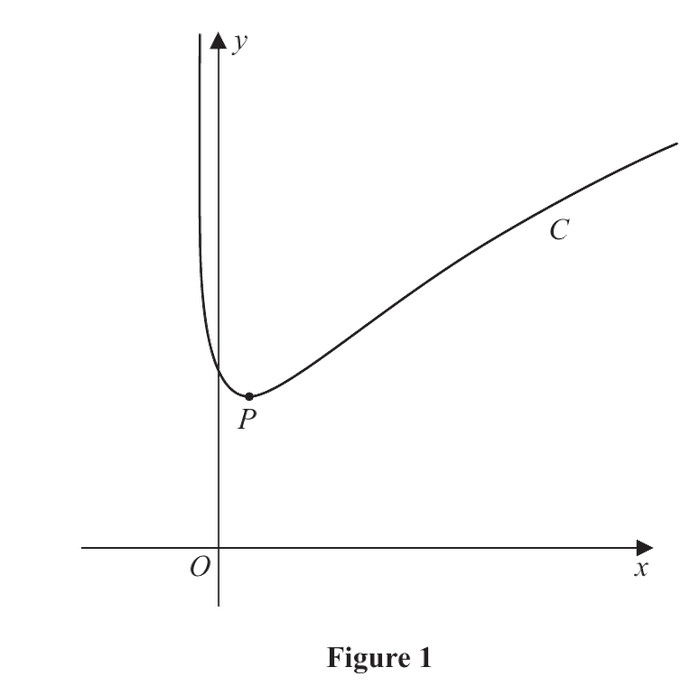
The curve C, shown in Figure 1, has equation
y2x+3y=4x2+ky>0
where k is a constant.
(a) Find dxdy in terms of x and y.
(5)
The point P(p,2), where p is a constant, lies on C.
Given that P is the minimum turning point on C,
(b) find
(i) the value of p
(ii) the value of k
(4)
题目中文翻译
图 1 所示曲线 C 的方程为
y2x+3y=4x2+ky>0
其中 k 为常数。
(a) 用 x,y 表示 dxdy。
点 P(p,2) 在曲线 C 上,其中 p 为常数。
已知 P 是曲线 C 的极小转折点,
(b) 求
(i) p 的值;
(ii) k 的值。
解答
(a)
解法一
思路
展开
这是隐函数求导。因为 y 是 x 的函数,所以对 xy2 要用乘积法则,对 3y 要乘上 dxdy。最后把所有含 dxdy 的项移到同一边并提取出来。
答题过程
展开
The curve is
xy2+3y=4x2+k.
Differentiate implicitly with respect to x:
dxd(xy2)+dxd(3y)(x⋅2ydxdy+y2)+3dxdy=dxd(4x2+k)=8x.
So
2xydxdy+y2+3dxdy=8x.
Collect the derivative terms:
(2xy+3)dxdy=8x−y2.
Therefore
dxdy=2xy+38x−y2.
(b)
解法一
思路
展开
转折点处切线水平,所以 dxdy=0。在 (a) 的表达式中,分母不为零时,导数为 0 等价于分子为 0。题目给出点是 (p,2),所以代入 y=2 求 p,再代回曲线方程求 k。
答题过程
展开
At a turning point,
dxdy=0.
Using the result from part (a),
2xy+38x−y2=0.
For the point P(p,2), substitute y=2:
8p−228p−4p=0=0=21.
Now substitute x=21 and y=2 into the curve:
xy2+3y=4x2+k.
This gives
21(22)+3(2)2+6k=4(21)2+k=1+k=7.
Therefore
p=21,k=7.
解法二
思路
展开
也可以不用导数求 p。把 y=2 代入曲线,得到关于 x 的二次方程。因为 P 是极小转折点,直线 y=2 与曲线在该点相切,所以这个二次方程有重根。由完成平方或判别式为零可以同时求出 p 和 k。
答题过程
展开
At P(p,2), substitute y=2 into the curve:
x(22)+3(2)=4x2+k.
So
4x+6=4x2+k,
or
4x2−4x+k−6=0.
Complete the square:
4x2−4x+k−6=4(x2−x)+k−6=4[(x−21)2−41]+k−6=4(x−21)2+k−7.
For P to be a turning point at y=2, this equation must have a repeated root. Hence
k−7=0,
so
k=7.
Then
4(x−21)2=0,
which gives
p=21.
Therefore
p=21,k=7.