Skip to content
CalcGospel 國際數學圖譜
返回

P4 2024 Oct Q3

A Level / Edexcel / P4

IAL 2024 Oct Paper · Question 3

题目

Problem

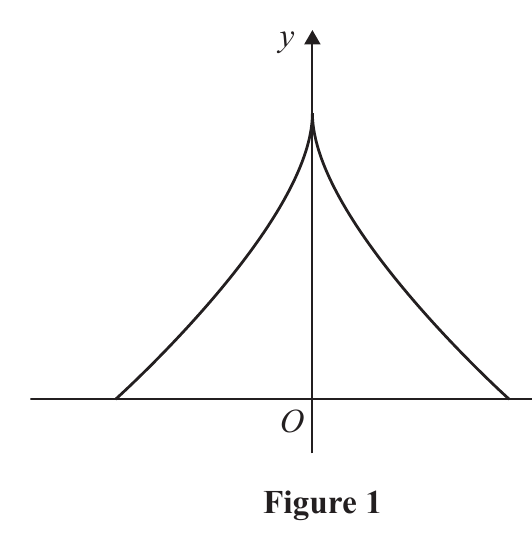
Figure 1 shows a sketch of the curve CC with parametric equations

x= 3sin⁡3θy= 1+cos⁡2θ −π2≤θ≤π2\begin{align*} x=&\,3\sin^3\theta\\ y=&\,1+\cos 2\theta\\ &\,-\frac{\pi}{2}\le \theta \le \frac{\pi}{2} \end{align*}

(a) Show that

dydx=kcosec⁡θθ≠0\frac{\mathrm{d}y}{\mathrm{d}x}=k\operatorname{cosec}\theta\qquad \theta\ne 0

where kk is a constant to be found.

(3)

The point PP lies on CC where θ=π6\theta=\dfrac{\pi}{6}.

(b) Find the equation of the tangent to CC at PP, giving your answer in the form ax+by+c=0ax+by+c=0 where a,ba,b and cc are integers.

(3)

(c) Show that CC has Cartesian equation

8x2=9(2−y)3−q≤x≤q8x^2=9(2-y)^3\qquad -q\le x\le q

where qq is a constant to be found.

(3)
题目中文翻译

图 1 给出了曲线 CC 的草图,其参数方程为

x= 3sin⁡3θy= 1+cos⁡2θ −π2≤θ≤π2\begin{align*} x=&\,3\sin^3\theta\\ y=&\,1+\cos 2\theta\\ &\,-\frac{\pi}{2}\le \theta \le \frac{\pi}{2} \end{align*}

(a) 证明

dydx=kcosec⁡θθ≠0\frac{\mathrm{d}y}{\mathrm{d}x}=k\operatorname{cosec}\theta\qquad \theta\ne 0

其中 kk 是待求常数。

(3)

点 PP 在曲线 CC 上,且 θ=π6\theta=\dfrac{\pi}{6}。

(b) 求曲线 CC 在点 PP 处的切线方程,答案写成 ax+by+c=0ax+by+c=0 的形式,其中 a,b,ca,b,c 为整数。

(3)

(c) 证明曲线 CC 的直角坐标方程为

8x2=9(2−y)3−q≤x≤q8x^2=9(2-y)^3\qquad -q\le x\le q

其中 qq 是待求常数。

(3)

解答

(a)

解法一

思路

展开

分别对参数求导,再用两个导数相除;以二倍角公式化简得到余割形式。

答题过程

展开

Differentiate the parametric equations:

dxdθ=9sin⁡2θcos⁡θ\frac{\mathrm{d}x}{\mathrm{d}\theta}=9\sin^2\theta\cos\theta

and

dydθ= −2sin⁡2θ= −4sin⁡θcos⁡θ.\begin{align*} \frac{\mathrm{d}y}{\mathrm{d}\theta} =&\,-2\sin2\theta\\ =&\,-4\sin\theta\cos\theta. \end{align*}

For a parametric curve, the gradient is the yy-derivative divided by the xx-derivative. Hence

dydx= −4sin⁡θcos⁡θ9sin⁡2θcos⁡θ= −49sin⁡θ= −49cosec⁡θ.\begin{align*} \frac{\mathrm{d}y}{\mathrm{d}x} =&\,\frac{-4\sin\theta\cos\theta}{9\sin^2\theta\cos\theta}\\ =&\,-\frac4{9\sin\theta}\\ =&\,-\frac49\operatorname{cosec}\theta. \end{align*}

Thus, in the required form,

k=−49.\boxed{k=-\frac49}.

解法二

思路

展开

先由参数方程证明消参关系,再隐式求导并代回参数。不直接借用 (c) 中尚待证明的给定式。

答题过程

展开

First derive the Cartesian relation from the parametric equations. Using cos⁡2θ=1−2sin⁡2θ\cos2\theta=1-2\sin^2\theta,

2−y=2sin⁡2θ.2-y=2\sin^2\theta.

Also,

8x2=8(3sin⁡3θ)2=72sin⁡6θ8x^2=8(3\sin^3\theta)^2=72\sin^6\theta

and

9(2−y)3=9(2sin⁡2θ)3=72sin⁡6θ.9(2-y)^3=9(2\sin^2\theta)^3=72\sin^6\theta.

Therefore

8x2=9(2−y)3.8x^2=9(2-y)^3.

Differentiate implicitly with respect to xx:

16x=−27(2−y)2dydx.16x=-27(2-y)^2\frac{\mathrm{d}y}{\mathrm{d}x}.

Thus

dydx=−16x27(2−y)2.\frac{\mathrm{d}y}{\mathrm{d}x}=-\frac{16x}{27(2-y)^2}.

Substitute x=3sin⁡3θx=3\sin^3\theta and 2−y=2sin⁡2θ2-y=2\sin^2\theta. The numerator and denominator simplify to

16x=48sin⁡3θ16x=48\sin^3\theta

and

27(2−y)2=108sin⁡4θ.27(2-y)^2=108\sin^4\theta.

Hence

dydx= −48sin⁡3θ108sin⁡4θ= −49cosec⁡θ.\begin{align*} \frac{\mathrm{d}y}{\mathrm{d}x} =&\,-\frac{48\sin^3\theta}{108\sin^4\theta}\\ =&\,-\frac49\operatorname{cosec}\theta. \end{align*}

Therefore

k=−49.\boxed{k=-\frac49}.

(b)

解法一

思路

展开

代入参数求点坐标和切线梯度,用点斜式写切线,再化为整数系数的一般式。

答题过程

展开

At PP,

θ=π6\theta=\frac{\pi}{6}

First find the coordinates of PP.

x= 3(12)3= 38.\begin{align*} x=&\,3\bigg(\frac12\bigg)^3\\ =&\,\frac38. \end{align*}

Also,

y=1+cos⁡π3=1+12=32y=1+\cos\frac{\pi}{3} =1+\frac12 =\frac32

Now find the gradient:

dydx= −49×2= −89.\begin{align*} \frac{\mathrm{d}y}{\mathrm{d}x} =&\,-\frac49\times2\\ =&\,-\frac89. \end{align*}

So the tangent at PP is

y−32=−89(x−38)y-\frac32=-\frac89\big(x-\frac38\big)

Multiply by 1818:

18y−27=−16x+618y-27=-16x+6

Therefore

16x+18y−33=0\boxed{16x+18y-33=0}

(c)

解法一

思路

展开

由实立方根直接表示 sin⁡θ\sin\theta,将 yy 写成新变量的函数,再立方并代回 xx。范围从原参数区间推出。

答题过程

展开

Let

s=x/33.s=\sqrt[3]{x/3}.

From x=3sin⁡3θx=3\sin^3\theta, s=sin⁡θs=\sin\theta. Therefore

y= 1+cos⁡2θ= 2−2s2.\begin{align*} y=&\,1+\cos2\theta\\ =&\,2-2s^2. \end{align*}

So 2−y=2s22-y=2s^2. Cubing gives

(2−y)3=8s6.(2-y)^3=8s^6.

Since s3=x/3s^3=x/3, we have s6=x2/9s^6=x^2/9. Hence

(2−y)3=8x29,(2-y)^3=\frac{8x^2}{9},

which rearranges to

8x2=9(2−y)3.\boxed{8x^2=9(2-y)^3}.

For −π/2≤θ≤π/2-\pi/2\le\theta\le\pi/2, sin⁡θ\sin\theta takes every value from −1-1 to 11. Thus x=3sin⁡3θx=3\sin^3\theta takes every value from −3-3 to 33, giving

−3≤x≤3,q=3.\boxed{-3\le x\le3,\qquad q=3}.

解法二

思路

展开

分别把目标等式的两边化为 72sin⁡6θ72\sin^6\theta,证明它们相等,再由参数范围求 qq。

答题过程

展开

From

x=3sin⁡3θx=3\sin^3\theta

we get

x2=9sin⁡6θx^2=9\sin^6\theta

So

8x2=72sin⁡6θ8x^2=72\sin^6\theta

Now

y=1+cos⁡2θy=1+\cos2\theta

Using

cos⁡2θ=1−2sin⁡2θ\cos2\theta=1-2\sin^2\theta

we get

y=1+1−2sin⁡2θy=1+1-2\sin^2\theta

Thus

2−y=2sin⁡2θ2-y=2\sin^2\theta

Therefore

9(2−y)3= 9(2sin⁡2θ)3= 72sin⁡6θ.\begin{align*} 9(2-y)^3=&\,9(2\sin^2\theta)^3\\ =&\,72\sin^6\theta. \end{align*}

Hence

8x2=9(2−y)38x^2=9(2-y)^3

Also, since

−π2≤θ≤π2-\frac{\pi}{2}\le \theta\le \frac{\pi}{2}

we have

−1≤sin⁡θ≤1-1\le \sin\theta\le 1

So

−3≤3sin⁡3θ≤3-3\le 3\sin^3\theta\le 3

and hence

−3≤x≤3-3\le x\le 3

Therefore

q=3\boxed{q=3}