题目
Problem
Pieces of wood cladding are produced by a timber merchant. There are three types of fault, A, B and C, that can appear in each piece of wood cladding.
The Venn diagram shows the probabilities of a piece of wood cladding having the various types of fault.
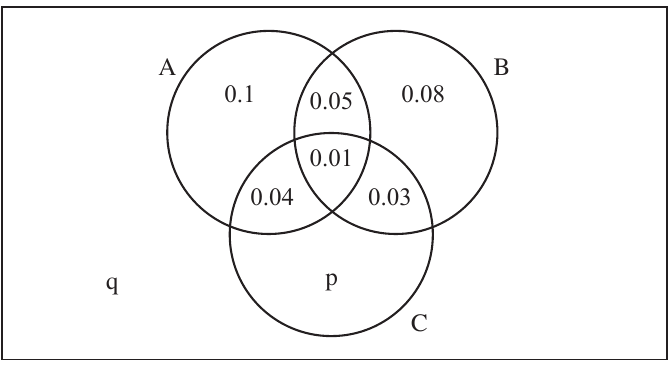
A piece of wood cladding is chosen at random.
(a) Find the probability that the piece of wood cladding has more than one type of fault.
(1)
Fault types A and C occur independently.
(b) Find the probability that the piece of wood cladding has no faults.
(4)
Given that the piece of wood cladding has fault A,
(c) find the probability that it also has fault B but not fault C.
(2)
Two pieces of the wood cladding are selected at random.
(d) Find the probability that both have exactly 2 types of fault.
(3)
解答
解法一
思路
展开
“more than one type of fault” 包括所有两两重叠和三重重叠。求 p 时用 A 和 C 独立,即 P(A∩C)=P(A)P(C)。
答题过程
展开
The probability of more than one type of fault is
0.05+0.04+0.03+0.01=0.13.
From the diagram,
P(A)=0.10+0.05+0.04+0.01=0.20.
Also,
P(C)=p+0.04+0.01+0.03=p+0.08.
Since A and C are independent,
P(A∩C)=P(A)P(C).
So
0.04+0.01=0.20(p+0.08).
Thus
0.05=0.20p+0.016.
Hence
p=0.17.
The probability of having at least one fault is
0.10+0.05+0.08+0.04+0.01+0.03+0.17=0.48.
Therefore the probability of no faults is
q=1−0.48=0.52.
Given fault A, the probability that the piece also has fault B but not C is
0.200.05=0.25.
The probability that one piece has exactly 2 types of fault is
0.05+0.04+0.03=0.12.
For two independent pieces, the probability that both have exactly 2 types of fault is
(0.12)2=0.0144.