题目
Problem
A group of 40 families was asked whether their family had a dog, a cat or a rabbit as pets.
No family had a dog and a rabbit
2 families had both a dog and a cat
12 families had a dog
14 families had a cat
11 families had a rabbit
9 families did not have any of these animals as pets
A family from this group is selected at random.
D represents the event that the family has a dog
C represents the event that the family has a cat
R represents the event that the family has a rabbit
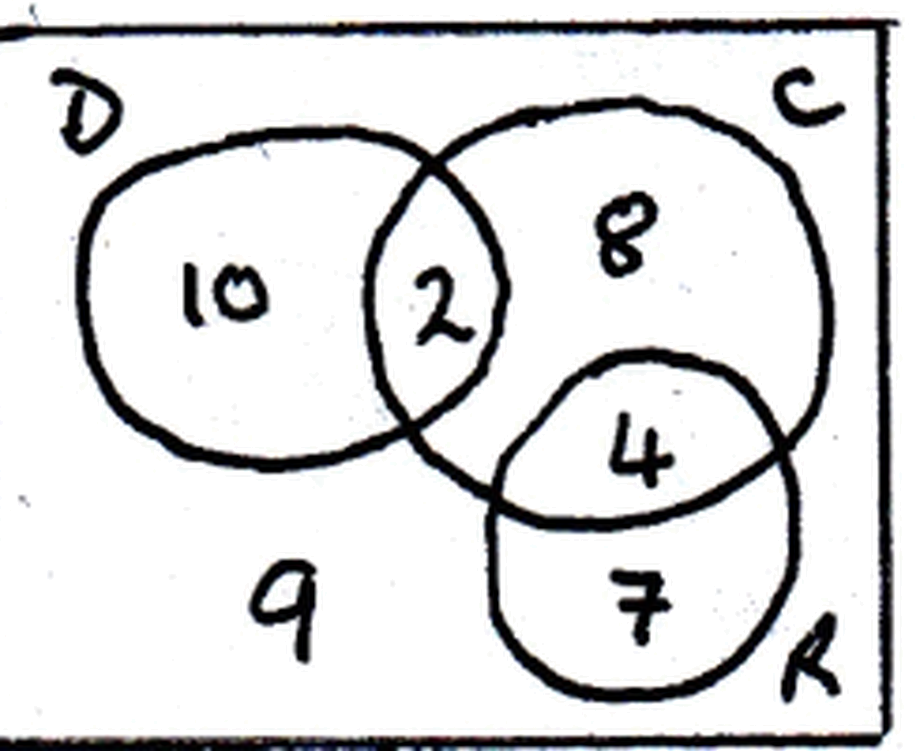
(a) Draw a Venn diagram to illustrate this information.
(4)
(b) State, giving a reason, a pair of mutually exclusive events from D, C and R.
(1)
(c) Find the probability that the family has exactly 2 of these kinds of animals as pets.
(1)
(d) Showing your working clearly, determine whether or not the events D and C are independent.
(2)
Sarah’s family is in the group and her family has a pet cat.
(e) Find the probability that Sarah’s family also has a pet rabbit.
(2)
(f) Find the exact value of P([D∪R]∣C′)
(2)
解答
(a)
解法一
思路
展开
先放最明确的重叠:D∩R=0,D∩C=2。再用各集合总数倒推出只在单个集合或其他重叠中的人数。
答题过程
展开
Since no family had a dog and a rabbit,
n(D∩R)=0.
Also,
n(D∩C)=2.
Since n(D)=12, the dog-only region is
12−2=10.
There are 9 families outside all three circles.
The total number inside at least one circle is
40−9=31.
Using the other totals, the completed regions are:
regionD onlyC onlyR onlyD∩C onlyC∩R onlyD∩Routsidenumber10872409
The completed diagram is
(b)
解法一
思路
展开
互斥表示没有交集。题目直接给了 no family had a dog and a rabbit。
答题过程
展开
D and R are mutually exclusive, since
P(D∩R)=0.
(c)
解法一
思路
展开
恰好两种宠物,对应 D∩C 和 C∩R 两块,因为 D∩R=0。
答题过程
展开
The number of families with exactly 2 kinds of pets is
2+4=6.
So the probability is
406=203.
(d)
解法一
思路
展开
检验独立性可以比较 P(D∩C) 与 P(D)P(C)。
答题过程
展开
P(D∩C)=402=201.
Also,
P(D)=4012=103
and
P(C)=4014=207.
So
P(D)P(C)=103⋅207=20021.
Since
201=20021,
the events D and C are not independent.
解法二
思路
展开
条件概率独立性判定法。
除了使用乘积公式 P(D∩C)=P(D)P(C) 检验独立性外,也可以利用条件概率进行判定:
P(C∣D)=P(C)或P(D∣C)=P(D)
本解法通过计算在有狗的前提下家庭有猫的条件概率 P(C∣D),并与无条件概率 P(C) 作比较。如果两者相等,则说明 D 发生与否不改变 C 发生的概率,即两事件独立;若不等,则不独立。这种方法直接从独立性的实际统计学意义出发,计算形式也更为简单。
答题过程
展开
We can test for independence by checking if P(C∣D)=P(C) (or equivalently, P(D∣C)=P(D)).
From the Venn diagram, we have:
P(C)=P(D)=4014=207,4012=103.
Calculate the conditional probability P(C∣D):
P(C∣D)====P(D)P(C∩D)12/402/4012261.
Since:
P(C∣D)=61=207=P(C),
the events D and C are not independent.
(Note: Alternatively, we can calculate P(D∣C)=P(C)P(C∩D)=142=71. Since P(D∣C)=P(D)=103, they are not independent.)
(e)
解法一
思路
展开
已知 Sarah 家有 cat,所以分母是所有有 cat 的 14 家;其中也有 rabbit 的是 4 家。
答题过程
展开
P(R∣C)=P(C)P(R∩C)=144=72.
(f)
解法一
思路
展开
条件是没有 cat。没有 cat 的家庭共有 10+7+9=26 家,其中有 dog 或 rabbit 的是 10+7=17 家。
答题过程
展开
Among families without a cat, the total number is
10+7+9=26.
Among these, the number with a dog or a rabbit is
10+7=17.
Therefore
P([D∪R]∣C′)=2617.