题目
Problem
In a school canteen, students can choose from a main course of meat (M), fish (F) or vegetarian (V). They can then choose a drink of either water (W) or juice (J).
The partially completed tree diagram, where p and q are probabilities, shows the probabilities of these choices for a randomly selected student.
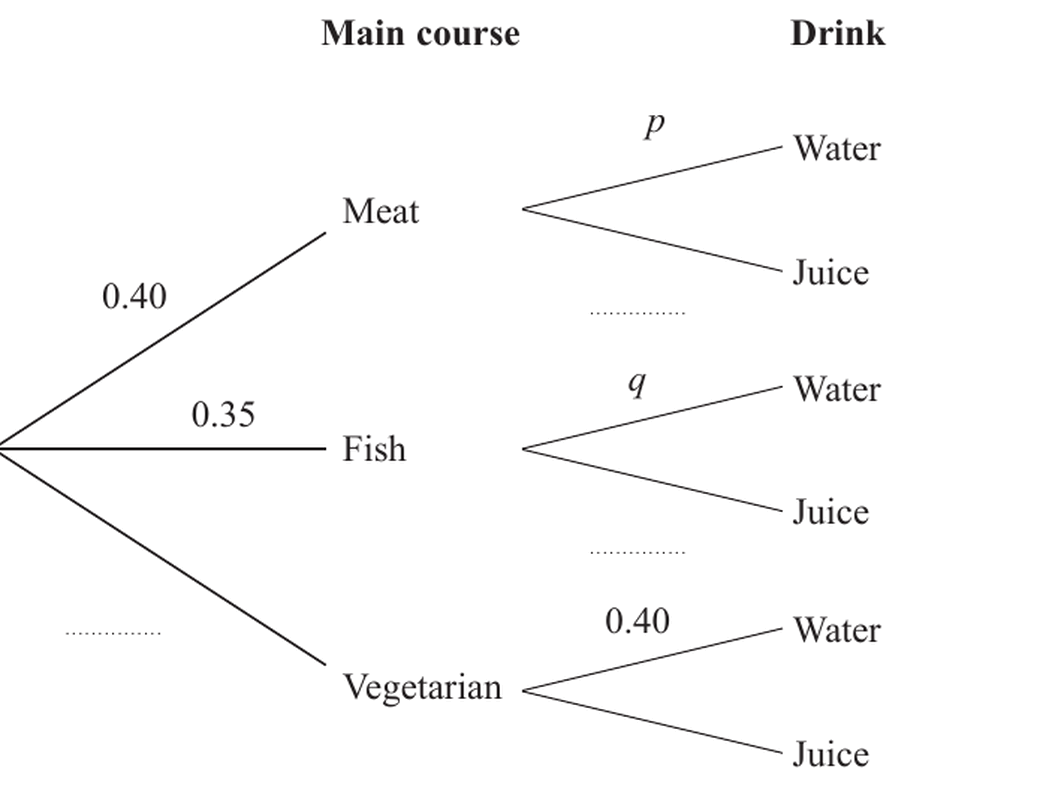
(a) Complete the tree diagram, giving your answers in terms of p and q where appropriate.
(2)
(b) Find an expression, in terms of p and q, for the probability that a randomly selected student chooses water to drink.
(1)
The events “choosing a vegetarian main course” and “choosing water to drink” are independent.
(c) Find a linear equation in terms of p and q.
(2)
A student who has chosen juice to drink is selected at random. The probability that they chose fish for their main course is 307
(d) Find the value of p and the value of q.
(5)
The canteen manager claims that students who choose water to drink are most likely to choose a fish main course.
(e) State, showing your working clearly, whether or not the manager’s claim is correct.
(3)
解答
(a)
解法一
思路
展开
第一层主菜概率相加为 1,所以 vegetarian 的概率是 0.25。每个主菜后的 water 和 juice 概率也相加为 1。
答题过程
展开
The probability of vegetarian is
1−0.40−0.35=0.25.
The missing drink probabilities are
P(J∣M)=1−p,P(J∣F)=1−q,P(J∣V)=0.60.
(b)
解法一
思路
展开
选择 water 可以来自三个主菜分支,把三条路径的概率相加。
答题过程
展开
P(W)===P(M∩W)+P(F∩W)+P(V∩W)0.40p+0.35q+0.25(0.40)0.40p+0.35q+0.10.
(c)
解法一
思路
展开
V 和 W 独立,所以 P(W∣V)=P(W)。树图中 P(W∣V)=0.40。
答题过程
展开
Since choosing vegetarian and choosing water are independent,
P(W)=P(W∣V).
Therefore
0.40p+0.35q+0.10=0.40.
So
0.40p+0.35q=0.30.
Multiplying by 20 gives
8p+7q=6.
(d)
解法一
思路
展开
先利用独立性得到 P(J)=0.60,再用给出的条件概率 P(F∣J)=307 求 q,最后代回线性方程求 p。
答题过程
展开
Since P(W)=0.40,
P(J)=1−0.40=0.60.
Given
P(F∣J)=307,
we have
P(J)P(F∩J)=307.
Thus
0.600.35(1−q)=307.
So
0.35(1−q)=0.14.
Hence
1−q=0.40,
and
q=0.60.
Using 8p+7q=6,
8p+7(0.60)=6.
So
8p=1.8,
and
p=0.225.
(e)
解法一
思路
展开
要比较的是在已经选择 water 的条件下,三种主菜哪个概率最大。由于 V 和 W 独立,P(V∣W)=P(V)=0.25。再算 fish 即可。
答题过程
展开
Since V and W are independent,
P(V∣W)=P(V)=0.25.
Also,
P(M∣W)=P(W)P(M∩W)=0.400.40(0.225)=0.225.
For fish,
P(F∣W)=P(W)P(F∩W)=0.400.35(0.60)=0.525.
Since
0.525>0.25>0.225,
the manager’s claim is correct.