题目
Problem
The Venn diagram shows the events A, B and C and their associated probabilities, where p and q are probabilities.
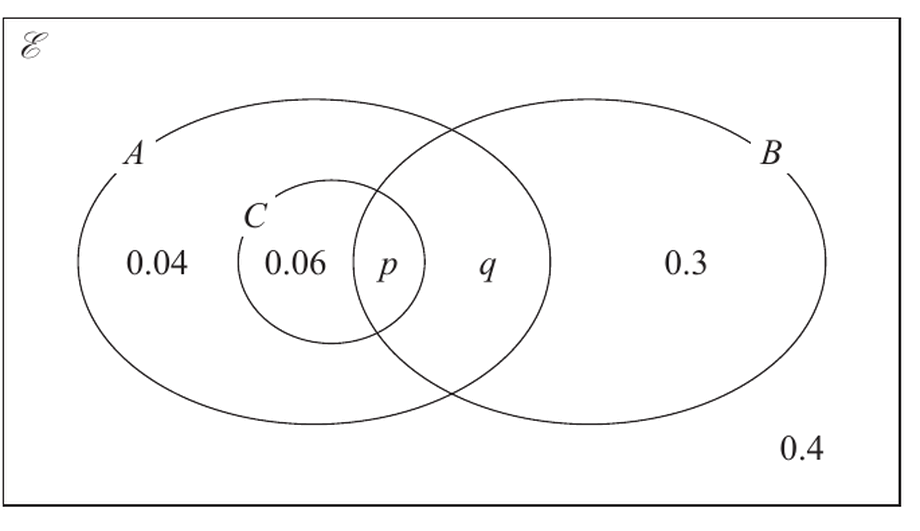
Venn diagram
(a) Find P(B)
(1)
(b) Determine whether or not A and B are independent.
(2)
Given that P(C∣B)=P(C)
(c) find the value of p and the value of q
(3)
The event D is such that
- A and D are mutually exclusive
- P(B∩D)>0
(d) On the Venn diagram show a possible position for the event D
(1)
解答
(a)
解法一
思路
展开
先用全概率为 1 得 p+q=0.2,再把 B 中的区域加起来。
答题过程
展开
Since the total probability is 1,
p+q=1−(0.04+0.06+0.3+0.4)=0.2.
Therefore
P(B)=p+q+0.3=0.5.
(b)
解法一
思路
展开
检验独立性用 P(A∩B)=P(A)P(B)。
答题过程
展开
From the diagram,
P(A)=0.04+0.06+p+q=0.3.
Also,
P(A∩B)=p+q=0.2.
But
P(A)P(B)=0.3(0.5)=0.15.
Since
P(A∩B)=P(A)P(B),
A and B are not independent.
解法二
思路
展开
条件概率独立性判定法。
判定两个事件 A 与 B 是否独立,除了检验乘积公式 P(A∩B)=P(A)P(B) 外,还可以检验条件概率是否等于无条件概率,即:
P(A∣B)=P(A)或P(B∣A)=P(B)
本解法通过计算在 B 发生的前提下 A 发生的条件概率 P(A∣B),并将其与 P(A) 作对比。若两者相等,则独立;若不等,则不独立。这种方法直接从“一个事件的发生是否改变另一个事件发生的概率”这一直观意义出发,在考场中也极易书写。
答题过程
展开
We can test for independence by checking if P(A∣B)=P(A) (or equivalently, P(B∣A)=P(B)).
From the Venn diagram, we have:
P(A)=P(B)=P(A∩B)=0.04+0.06+p+q=0.3,0.5,p+q=0.2.
Calculate the conditional probability P(A∣B):
P(A∣B)===P(B)P(A∩B)0.50.20.4.
Since:
P(A∣B)=0.4=0.3=P(A),
the occurrence of event B affects the probability of event A occurring.
Therefore, A and B are not independent.
(Note: Alternatively, we can calculate P(B∣A)=P(A)P(A∩B)=0.30.2=32≈0.667. Since P(B∣A)=P(B)=0.5, they are not independent.)
(c)
解法一
思路
展开
P(C∣B)=P(C) 表示用条件概率列方程。图中 B∩C 的区域是 p,而 C 的概率是 p+0.06。
答题过程
展开
Using P(C∣B)=P(C),
0.5p=p+0.06.
So
2p=p+0.06.
Hence
p=0.06.
Since p+q=0.2,
q=0.14.
(d)
解法一
思路
展开
D 不能与 A 重叠,但要与 B 有交集,所以可以把 D 画在 B 的右侧、避开 A 的位置。
答题过程
展开
Draw D so that it overlaps B but does not overlap A.