题目
Problem
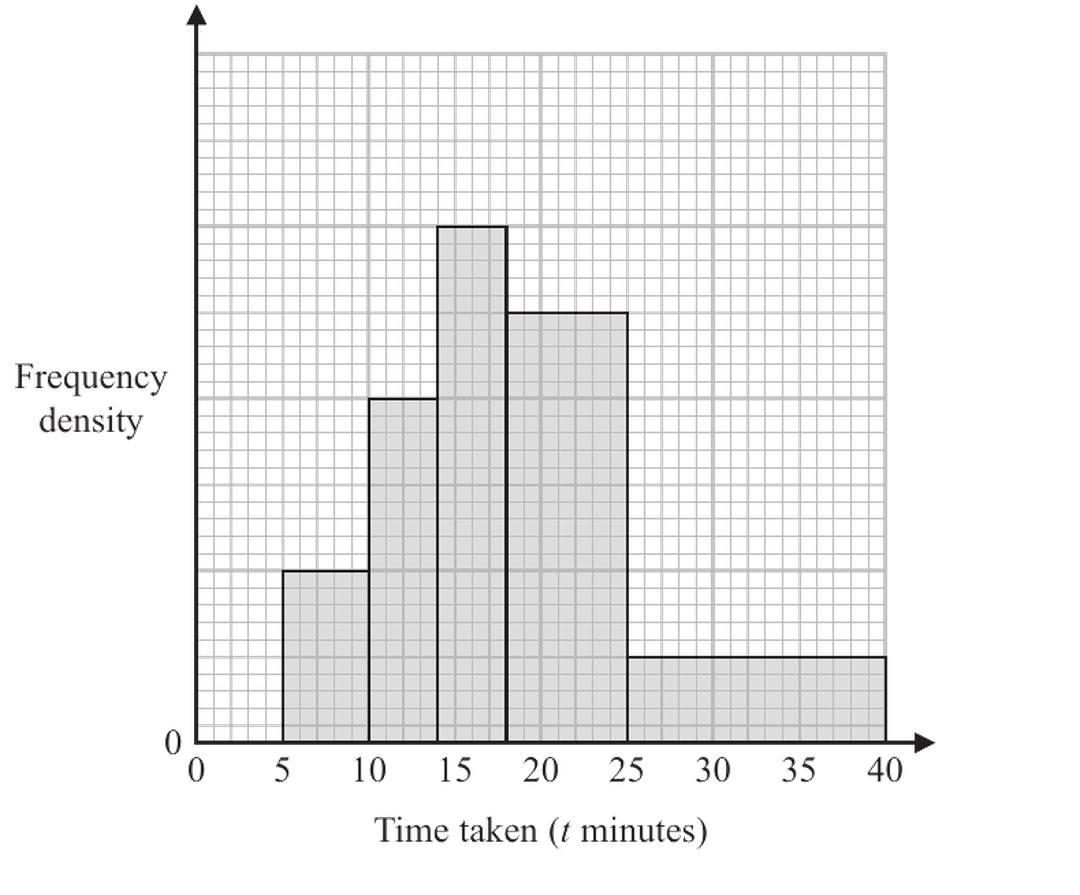
The histogram shows the times taken, t t t 100 100 100 500 500 500
Histogram (a) Use the histogram to complete the frequency table for the times taken by the 100 100 100 500 500 500
Time taken ( t minutes ) 5 − 10 10 − 14 14 − 18 18 − 25 25 − 40 Frequency ( f ) 10 16 24 \begin{array}{c|ccccc}
\text{Time taken }(t\text{ minutes})&5-10&10-14&14-18&18-25&25-40\\
\hline
\text{Frequency }(f)&10&16&24&&
\end{array} Time taken ( t minutes ) Frequency ( f ) 5 − 10 10 10 − 14 16 14 − 18 24 18 − 25 25 − 40 (1)
(b) Estimate the number of people who took less than 16 16 16 500 500 500
(2)
(c) Find an estimate for the mean time taken to swim 500 500 500
(2)
Given that ∑ f t 2 = 41033 \sum ft^2=41033 ∑ f t 2 = 41033
(d) find an estimate for the standard deviation of the times taken to swim 500 500 500
(2)
Given that Q 3 = 23 Q_3=23 Q 3 = 23
(e) use linear interpolation to estimate the interquartile range of the times taken to swim 500 500 500
(3)
解答
(a)
解法一
思路
展开
直方图中 frequency = frequency density × \times ×
答题过程
展开
The completed frequencies are
Time taken ( t minutes ) 5 − 10 10 − 14 14 − 18 18 − 25 25 − 40 Frequency ( f ) 10 16 24 35 15 \begin{array}{c|ccccc}
\text{Time taken }(t\text{ minutes})&5-10&10-14&14-18&18-25&25-40\\
\hline
\text{Frequency }(f)&10&16&24&35&15
\end{array} Time taken ( t minutes ) Frequency ( f ) 5 − 10 10 10 − 14 16 14 − 18 24 18 − 25 35 25 − 40 15 (b)
解法一
思路
展开
少于 16 16 16 14 14 14 16 16 16 14 14 14 18 18 18
答题过程
展开
number = 10 + 16 + 16 − 14 18 − 14 ( 24 ) = 10 + 16 + 12 = 38. \begin{align*}
\text{number}
=&\,10+16+\frac{16-14}{18-14}(24)\\[3mm]
=&\,10+16+12\\[3mm]
=&\,38.
\end{align*} number = = = 10 + 16 + 18 − 14 16 − 14 ( 24 ) 10 + 16 + 12 38. 解法二
思路
展开
直观比例计算法。
前两个区间 5 − 10 5-10 5 − 10 10 − 14 10-14 10 − 14 10 10 10 16 16 16 14 − 18 14-18 14 − 18 18 − 14 = 4 18 - 14 = 4 18 − 14 = 4 24 24 24 16 16 16 16 − 14 = 2 16 - 14 = 2 16 − 14 = 2 2 4 = 50 % \frac{2}{4} = 50\% 4 2 = 50% 16 16 16
50 % × 24 = 12 人 \begin{align*}
50\% \times 24 = 12\text{ 人}
\end{align*} 50% × 24 = 12 人 最后将三部分人数加起来:
10 + 16 + 12 = 38 人 \begin{align*}
10 + 16 + 12 = 38\text{ 人}
\end{align*} 10 + 16 + 12 = 38 人 这种方法利用比例与分率的直观意义,避开了公式中的多重除法,有利于手算。
答题过程
展开
The number of people who took less than 16 16 16
All people in the interval [ 5 , 10 ] [5, 10] [ 5 , 10 ] 10 10 10
All people in the interval [ 10 , 14 ] [10, 14] [ 10 , 14 ] 16 16 16
A proportion of people in the interval [ 14 , 18 ] [14, 18] [ 14 , 18 ]
The width of the interval [ 14 , 18 ] [14, 18] [ 14 , 18 ]
18 − 14 = 4 minutes . \begin{align*}
18 - 14 = 4\text{ minutes}.
\end{align*} 18 − 14 = 4 minutes . The target range within this interval is [ 14 , 16 ] [14, 16] [ 14 , 16 ]
16 − 14 = 2 minutes . \begin{align*}
16 - 14 = 2\text{ minutes}.
\end{align*} 16 − 14 = 2 minutes . The proportion of people in this range is:
2 4 = 0.5. \begin{align*}
\frac{2}{4} = 0.5.
\end{align*} 4 2 = 0.5. Thus, the number of people in this range is:
0.5 × 24 = 12. \begin{align*}
0.5 \times 24 = 12.
\end{align*} 0.5 × 24 = 12. Summing all three parts:
Total number = 10 + 16 + 12 = 38. \begin{align*}
\text{Total number} =&\,\, 10 + 16 + 12\\[3mm]
=&\,\, 38.
\end{align*} Total number = = 10 + 16 + 12 38. (c)
解法一
思路
展开
用 grouped data midpoint 估计平均数。
答题过程
展开
∑ f t = 7.5 ( 10 ) + 12 ( 16 ) + 16 ( 24 ) + 21.5 ( 35 ) + 32.5 ( 15 ) = 1891. \begin{align*}
\sum ft
=&\,7.5(10)+12(16)+16(24)\\[3mm]
&\,\hspace{2pt}+21.5(35)+32.5(15)\\[3mm]
=&\,1891.
\end{align*} ∑ f t = = 7.5 ( 10 ) + 12 ( 16 ) + 16 ( 24 ) + 21.5 ( 35 ) + 32.5 ( 15 ) 1891. Therefore
t ˉ = 1891 100 = 18.91. \begin{align*}
\bar{t}=\frac{1891}{100}=18.91.
\end{align*} t ˉ = 100 1891 = 18.91. (d)
解法一
思路
展开
用公式
s = ∑ f t 2 ∑ f − t ˉ 2 . \begin{align*}
s=\sqrt{\frac{\sum ft^2}{\sum f}-\bar{t}^{\,2}}.
\end{align*} s = ∑ f ∑ f t 2 − t ˉ 2 . 答题过程
展开
s = 41033 100 − 18.91 2 = 7.262 … \begin{align*}
s
=&\,\sqrt{\frac{41033}{100}-18.91^2}\\[3mm]
=&\,7.262\ldots
\end{align*} s = = 100 41033 − 18.9 1 2 7.262 … So the standard deviation is
7.26 \begin{align*}
7.26
\end{align*} 7.26 to 3 3 3
(e)
解法一
思路
展开
Q 1 Q_1 Q 1 25 25 25 10 10 10 10 10 10 14 14 14 26 26 26 Q 1 Q_1 Q 1 10 10 10 14 14 14
答题过程
展开
For Q 1 Q_1 Q 1
Q 1 = 10 + 25 − 10 16 ( 14 − 10 ) = 13.75. \begin{align*}
Q_1=10+\frac{25-10}{16}(14-10)=13.75.
\end{align*} Q 1 = 10 + 16 25 − 10 ( 14 − 10 ) = 13.75. Therefore
IQR = Q 3 − Q 1 = 23 − 13.75 = 9.25. \begin{align*}
\operatorname{IQR}=Q_3-Q_1=23-13.75=9.25.
\end{align*} IQR = Q 3 − Q 1 = 23 − 13.75 = 9.25. 解法二
思路
展开
直观比例插值法。
下四分位数 Q 1 Q_1 Q 1 25 25 25 [ 10 , 14 ] [10, 14] [ 10 , 14 ] 10 10 10 Q 1 Q_1 Q 1 [ 10 , 14 ] [10, 14] [ 10 , 14 ] 25 − 10 = 15 25 - 10 = 15 25 − 10 = 15 16 16 16 14 − 10 = 4 14 - 10 = 4 14 − 10 = 4 Q 1 Q_1 Q 1
15 16 \begin{align*}
\frac{15}{16}
\end{align*} 16 15 对应实际分钟数为:
15 16 × 4 = 15 4 = 3.75 分钟 \begin{align*}
\frac{15}{16} \times 4 = \frac{15}{4} = 3.75\text{ 分钟}
\end{align*} 16 15 × 4 = 4 15 = 3.75 分钟 所以 Q 1 Q_1 Q 1
10 + 3.75 = 13.75 分钟 \begin{align*}
10 + 3.75 = 13.75\text{ 分钟}
\end{align*} 10 + 3.75 = 13.75 分钟 最后代入四分位距公式:
IQR = Q 3 − Q 1 = 23 − 13.75 = 9.25 \begin{align*}
\operatorname{IQR} = Q_3 - Q_1 = 23 - 13.75 = 9.25
\end{align*} IQR = Q 3 − Q 1 = 23 − 13.75 = 9.25 此方法通过将插值运算分解为比例与实际宽度的乘积,有助于学生理解插值法的实际物理背景。
答题过程
展开
The lower quartile Q 1 Q_1 Q 1 25 25 25 [ 10 , 14 ] [10, 14] [ 10 , 14 ] 10 10 10 Q 1 Q_1 Q 1 25 − 10 = 15 25 - 10 = 15 25 − 10 = 15 [ 10 , 14 ] [10, 14] [ 10 , 14 ] 16 16 16
The width of this class interval is:
14 − 10 = 4 minutes . \begin{align*}
14 - 10 = 4\text{ minutes}.
\end{align*} 14 − 10 = 4 minutes . The proportion of distance Q 1 Q_1 Q 1
15 16 . \begin{align*}
\frac{15}{16}.
\end{align*} 16 15 . The distance into the interval is:
15 16 × 4 = 3.75 minutes . \begin{align*}
\frac{15}{16} \times 4 = 3.75\text{ minutes}.
\end{align*} 16 15 × 4 = 3.75 minutes . Thus, the estimated lower quartile is:
Q 1 = 10 + 3.75 = 13.75. \begin{align*}
Q_1 = 10 + 3.75 = 13.75.
\end{align*} Q 1 = 10 + 3.75 = 13.75. Given Q 3 = 23 Q_3 = 23 Q 3 = 23
IQR = Q 3 − Q 1 = 23 − 13.75 = 9.25. \begin{align*}
\operatorname{IQR} =&\,\, Q_3 - Q_1\\[3mm]
=&\,\, 23 - 13.75\\[3mm]
=&\,\, 9.25.
\end{align*} IQR = = = Q 3 − Q 1 23 − 13.75 9.25.