题目
Problem
(i) In the Venn diagram below, A and B represent events and p, q, r and s are probabilities.
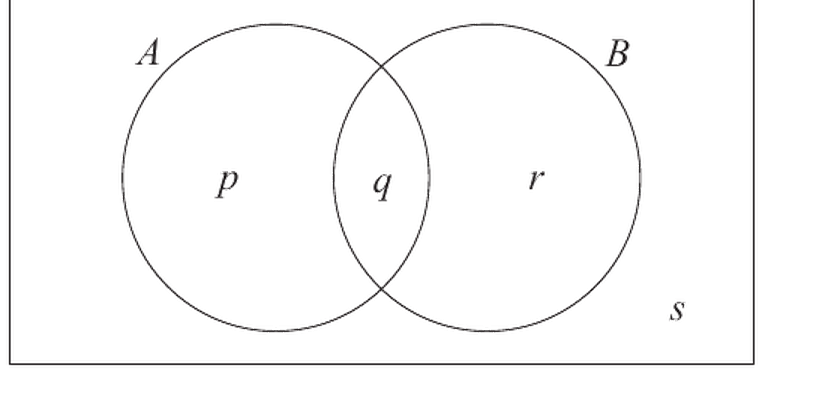
Venn diagram
P(A)=257P(B)=51P((A∩B′)∪(A′∩B))=258
(a) Use algebra to show that 2p+2q+2r=54
(4)
(b) Find the value of p, the value of q, the value of r and the value of s
(5)
(ii) Two events, C and D, are such that
P(C)=x+5xP(D)=x5
where x is a positive constant.
By considering P(C)+P(D) show that C and D cannot be mutually exclusive.
(4)
解答
(i)(a)
解法一
思路
展开
从 Venn 图可得 p+q=P(A),q+r=P(B),而“只在其中一个事件中”是 p+r。把三式相加就会出现 2p+2q+2r。
答题过程
展开
From the Venn diagram,
p+q=257.
Also,
q+r=51.
And
p+r=258.
Adding these three equations,
(p+q)+(q+r)+(p+r)=2p+2q+2r===257+51+258257+255+258252054.
(i)(b)
解法一
思路
展开
有三条关于 p,q,r 的方程,先由上一小题得到 p+q+r=52,再逐个相减。
答题过程
展开
From part (a),
p+q+r=52.
Since
q+r=51,
we have
p=52−51=51.
Since
p+r=258,
we have
r=258−51=253.
Then
q=51−253=252.
Finally,
s=1−(p+q+r)=1−52=53.
(ii)
解法一
思路
展开
如果两个事件互斥,则 P(C∪D)=P(C)+P(D),而联合概率不能超过 1。所以只要证明 P(C)+P(D)>1,就可说明它们不可能互斥。
答题过程
展开
Consider
P(C)+P(D)====x+5x+x5x(x+5)x2+5(x+5)x2+5xx2+5x+251+x2+5x25.
Since x>0,
x2+5x25>0.
Therefore
P(C)+P(D)>1.
If C and D were mutually exclusive, then P(C∪D)=P(C)+P(D)>1, which is impossible.
Hence C and D cannot be mutually exclusive.