题目
Problem
(i) Bob shops at a market each week. The event that
Bob buys carrots is denoted by C
Bob buys onions is denoted by O
At each visit, Bob may buy neither, or one, or both of these items. The probability that
Bob buys carrots is 0.65
Bob does not buy onions is 0.3
Bob buys onions but not carrots is 0.15
The Venn diagram below represents the events C and O
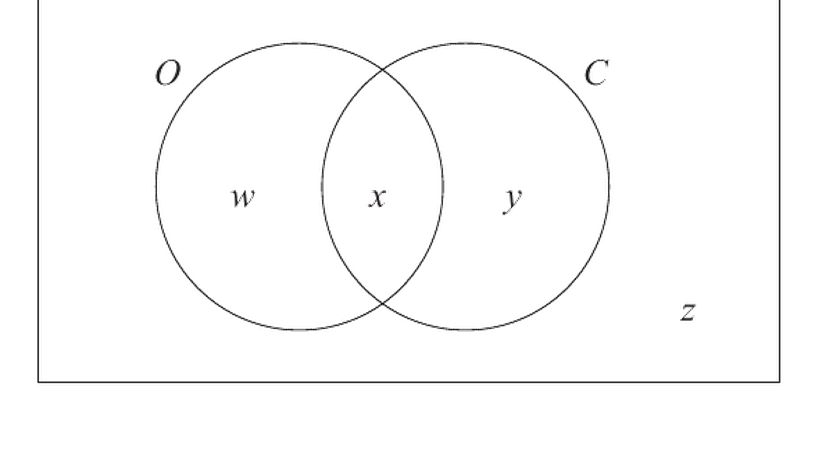
Venn diagram
where w, x, y and z are probabilities.
(a) Find the value of w, the value of x, the value of y and the value of z
(4)
For one visit to the market,
(b) find the probability that Bob buys either carrots or onions but not both.
(1)
(c) Show that the events C and O are not independent.
(2)
(ii) F, G and H are 3 events. F and H are mutually exclusive. F and G are independent.
Given that
P(F)=72P(H)=41P(F∪G)=85
(a) find P(F∪H)
(1)
(b) find P(G)
(3)
(c) find P(F∩G)
(1)
解答
(i)(a)
解法一
思路
展开
w 是“买 onions 但不买 carrots”,题目已经给出。因为 P(O)=1−0.3=0.7,所以可求交集 x;再由 P(C)=0.65 求 y,最后用总概率为 1 求 z。
答题过程
展开
Since Bob buys onions but not carrots with probability 0.15,
w=0.15.
Also,
P(O)=1−0.3=0.7.
So
x=0.7−0.15=0.55.
Since P(C)=0.65,
y=0.65−0.55=0.10.
Finally,
z=1−0.15−0.55−0.10=0.20.
(i)(b)
解法一
思路
展开
“买其中一种但不是两种”对应 Venn 图里只属于一个圆的两个区域:w 和 y。
答题过程
展开
P(carrots or onions but not both)===w+y0.15+0.100.25.
(i)(c)
解法一
思路
展开
若 C 和 O 独立,则必须满足 P(C∩O)=P(C)P(O)。这里左边是交集区域 x。
答题过程
展开
We have
P(C∩O)=0.55.
But
P(C)P(O)==0.65(0.7)0.455.
Since
P(C∩O)=P(C)P(O),
the events C and O are not independent.
(ii)(a)
解法一
思路
展开
F 和 H mutually exclusive,所以它们没有交集,联合概率直接相加。
答题过程
展开
Since F and H are mutually exclusive,
P(F∪H)===P(F)+P(H)72+412815.
(ii)(b)
解法一
思路
展开
用加法公式
P(F∪G)=P(F)+P(G)−P(F∩G).
又因为 F 和 G 独立,所以 P(F∩G)=P(F)P(G)。
答题过程
展开
Using independence,
P(F∩G)=P(F)P(G)=72P(G).
Therefore
85=85−72=5619=72+P(G)−72P(G)75P(G)75P(G).
Hence
P(G)=5619⋅57=4019.
解法二
思路
展开
对立事件独立性判定法。因为事件 F 和 G 独立,所以事件的补集 F′ 和 G 也相互独立。
由于整个样本空间可以划分为包含在 F 中以及在 F 之外但包含在 G 中两部分,我们有公式:
P(F∪G)=P(F)+P(F′∩G)
利用 F′ 和 G 的独立性:
P(F′∩G)=P(F′)P(G)=(1−P(F))P(G)
因此:
P(F∪G)=P(F)+(1−P(F))P(G)
代入已知数据即可轻松解出 P(G)。这种方法非常精炼,省去了代数化简和通分多项式的步骤。
答题过程
展开
Since F and G are independent, F′ and G are also independent.
We can express the union of F and G as:
P(F∪G)=P(F)+P(F′∩G).
Using the independence of F′ and G:
P(F∪G)=P(F)+P(F′)P(G).
Since P(F)=72, we have P(F′)=1−72=75.
Substitute the known probabilities:
85=75P(G)=75P(G)=75P(G)=72+75P(G)85−725635−165619.
Solve for P(G):
P(G)==5619⋅574019.
(ii)(c)
解法一
思路
展开
直接使用独立事件的交集公式。
答题过程
展开
Since F and G are independent,
P(F∩G)===P(F)P(G)72⋅401914019.