题目
Problem
In a sixth form college each student in Year 12 and Year 13 is either left-handed (L) or right-handed (R).
The partially completed tree diagram, where p is a probability, gives information about these students.
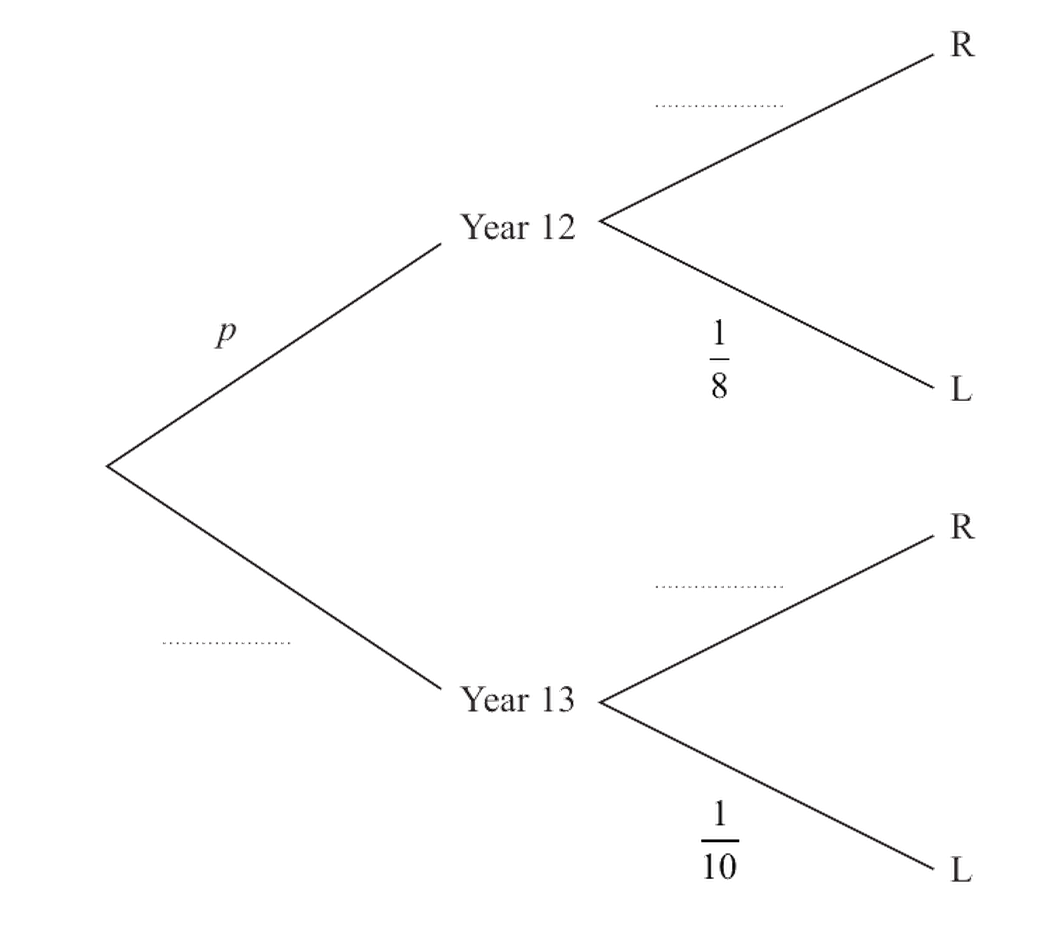
Tree diagram for year group and handedness
(a) Complete the tree diagram, in terms of p where necessary.
(1)
The probability that a student is left-handed is 0.11.
(b) Find the value of p.
(3)
(c) Find the probability that a student selected at random is in Year 12 and left-handed.
(2)
Given that a student is right-handed,
(d) find the probability that the student is in Year 12.
(2)
解答
(a)
解法一
思路
展开
每一处分支概率相加为 1。第一层 Year 12 是 p,所以 Year 13 是 1−p。Year 12 下的 left-handed 是 81,所以 right-handed 是 87。Year 13 下的 left-handed 是 101,所以 right-handed 是 109。
答题过程
展开
The missing probabilities are
1−p,87,109.
(b)
解法一
思路
展开
左撇子的总概率来自两条路径:Year 12 且 left-handed,或 Year 13 且 left-handed。
答题过程
展开
Since P(L)=0.11,
81p+101(1−p)=0.11.
Multiplying by 40,
5p+4(1−p)=p+4=p=4.44.40.4.
Therefore
p=52.
解法二
思路
展开
纯小数计算方程法。因为在统计学中分率经常与小数互换,我们可以直接将分数转换为小数进行运算:
81=0.125,101=0.1
我们列出方程:
0.125p+0.1(1−p)=0.11
然后直接化简并计算出 p。这种方法非常适合习惯在草稿纸上进行直接小手算、不倾向把方程转化成整数系数的同学。
答题过程
展开
Convert the fractions to decimals:
81=0.125,101=0.1.
We set up the equation:
0.125p+0.1(1−p)=0.11.
Expand and solve:
0.125p+0.1−0.1p=0.025p=p=p=0.110.010.0250.010.4.
Therefore, p=52 (or 0.4).
(c)
解法一
思路
展开
沿树图路径相乘:Year 12 的概率乘以 Year 12 条件下 left-handed 的概率。
答题过程
展开
P(Year 12 and L)===p⋅8152⋅81201.
(d)
解法一
思路
展开
这是条件概率:
P(Year 12∣R)=P(R)P(Year 12 and R).
已知 P(L)=0.11,所以 P(R)=0.89。
答题过程
展开
P(R)=1−0.11=0.89=10089.
Also,
P(Year 12 and R)==52⋅87207.
Therefore
P(Year 12∣R)===P(R)P(Year 12 and R)100892078935.
解法二
思路
展开
直接分支概率求和法。不通过 1−P(L) 来求 P(R),而是根据树状图的分支直接计算右撇子(right-handed)的概率。
右撇子可以来自:
- 处于 Year 12 且是右撇子(P(Year 12 and R))
- 处于 Year 13 且是右撇子(P(Year 13 and R))
我们将这两部分概率分别算出并求和得到 P(R),然后再套入条件概率公式中。这种方法比较直接,适合喜欢从树图直接求出各项分支概率的同学。
答题过程
展开
Calculate the probability of right-handed students directly from the tree branches:
P(R)==P(Year 12 and R)+P(Year 13 and R)p⋅87+(1−p)⋅109
Substitute p=0.4 (or 52):
P(R)=====52⋅87+53⋅109207+50270.35+0.540.8910089.
Now calculate the conditional probability:
P(Year 12∣R)===P(R)P(Year 12 and R)89/1007/208935.