题目
Problem
A manufacturer of pet food gives samples of three new flavours of cat food, A, B and C, to each of 100 customers who each own one cat.
These customers are surveyed to find out whether or not their cat likes each flavour with the following results
40 cats like A
45 cats like B
50 cats like C
19 cats like both A and B
20 cats like both A and C
22 cats like both B and C
12 cats like all three of these flavours.
(a) Using these results complete the Venn diagram below.
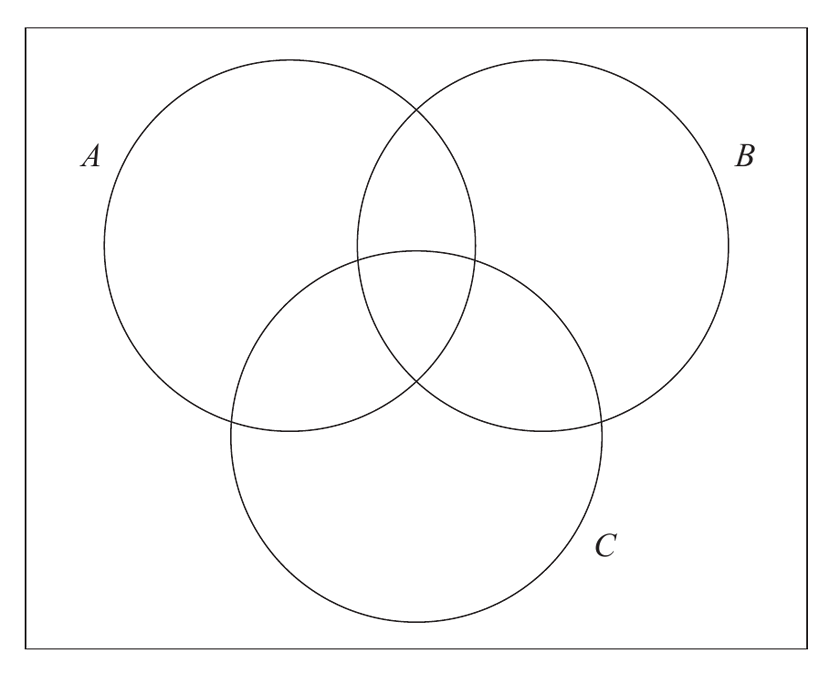
(4)
For these cats,
(b) determine whether or not a cat liking flavour A is independent of it liking flavour C
(2)
(c) One of these 100 cats is chosen at random.
(i) Find the probability that it likes only one of the three flavours.
(1)
(ii) Given that it likes flavour C, find the probability that it also likes flavour B
(2)
题目中文翻译
一家宠物食品制造商向 100 位各养一只猫的顾客提供 A、B、C 三种新口味猫粮的样品。调查每只猫是否喜欢各口味,结果如下:
- 40 只喜欢 A,45 只喜欢 B,50 只喜欢 C。
- 19 只同时喜欢 A 和 B,20 只同时喜欢 A 和 C,22 只同时喜欢 B 和 C。
- 12 只喜欢全部三种口味。
(a) 根据这些结果完成上方维恩图。(4 分)
对于这些猫,
(b) 判断喜欢 A 与喜欢 C 是否独立。(2 分)
(c) 从这 100 只猫中随机选取一只。
(i) 求它只喜欢三种口味中的一种的概率。(1 分)
(ii) 已知它喜欢 C,求它也喜欢 B 的概率。(2 分)
解答
(a)
解法一
思路
展开
先填中心 A∩B∩C=12。题目中的 “both” 包含三个都喜欢,所以每个两两交集区域都要减去 12。最后再用每个圆的总数求只属于单个圆的区域。
答题过程
展开
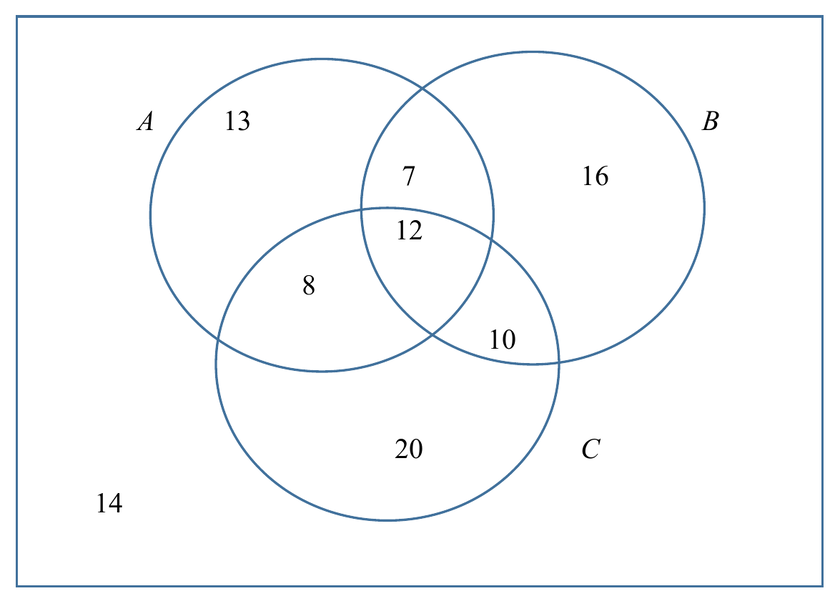
The centre region is
A∩B∩C=12.
The pairwise-only regions are
A∩B only=A∩C only=B∩C only=19−12=7,20−12=8,22−12=10.
Now find the single-flavour-only regions:
A only=B only=C only=40−7−8−12=13,45−7−10−12=16,50−8−10−12=20.
The number outside the three circles is
100=−(13+16+20+7+8+10+12)14.
(b)
解法一
思路
展开
判断 A 和 C 是否独立,可以检查
P(A∩C)=P(A)P(C).
答题过程
展开
P(A)=P(C)=10040,10050.
Also,
P(A∩C)=10020.
Now
P(A)P(C)===10040⋅1005010020P(A∩C).
Therefore liking flavour A and liking flavour C are independent.
解法二
思路
展开
也可比较 P(A∣C) 与 P(A);两者相等则事件独立。
答题过程
展开
First calculate the unconditional probability of a cat liking flavour A:
P(A)=10040=0.4.
Of the 50 cats liking C, 20 also like A. Therefore
P(A∣C)====P(C)P(A∩C)50/10020/10050200.4.
Since P(A∣C)=P(A), liking flavour A is independent of liking flavour C.
(c)(i)
解法一
思路
展开
“Only one flavour” 指只在 A、只在 B、只在 C 三个区域。把这三个区域相加,再除以 100。
答题过程
展开
The number of cats that like only one flavour is
13+16+20=49.
Therefore the probability is
10049.
(c)(ii)
解法一
思路
展开
已知喜欢 C,所以分母是 C 圆内总数 50。同时喜欢 B 和 C 的有 22 只,包括三者都喜欢的那部分。
答题过程
展开
P(B∣C)====P(C)P(B∩C)50/10022/10050222511.
