题目
Problem
Riley has a bag containing 3 white beads and 6 yellow beads only.
Two beads are selected at random from the bag, one at a time without replacement.
(a) Complete the tree diagram on page 21.
(3)
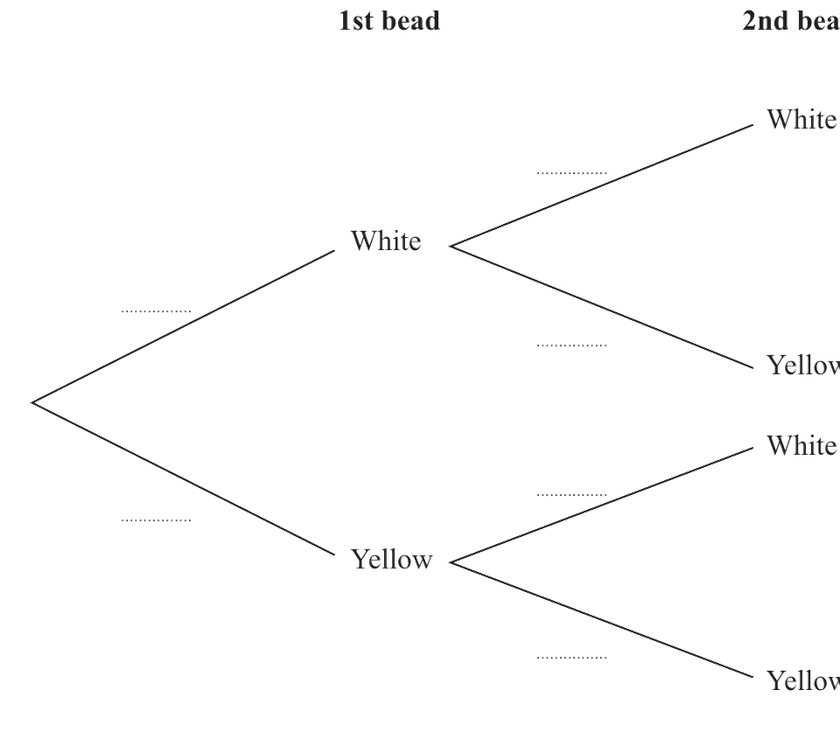
Tree diagram
(b) Find the probability that exactly one of the beads selected is yellow.
Show your working.
(2)
(c) Find the probability that at least one of the beads selected is white.
(2)
Given that at least one of the beads selected is white,
(d) find the probability that both of the beads selected are white.
(2)
Riley adds some beads to the bag so it contains a total of n beads.
The beads are either red or yellow or white such that
number of red beads:number of yellow beads:number of white beads=4:3:1.
Four beads are selected at random from the bag, one at a time without replacement.
The probability of getting 2 red beads, followed by a yellow bead, followed by a white bead is
2353.
(e) Show that n satisfies the equation
21n2+bn+c=0
where b and c are integers to be found.
(4)
解答
(a)
解法一
思路
展开
第一次抽之前一共有 9 个 beads,其中白色 3 个、黄色 6 个。因为是不放回抽样,第二次的分母会变成 8,而分子要根据第一次抽到什么来调整。
答题过程
展开
The completed probabilities are:
P(first white)=P(first yellow)=93,96.
If the first bead is white, then 2 white and 6 yellow beads remain, out of 8 beads:
P(second white∣first white)=P(second yellow∣first white)=82,86.
If the first bead is yellow, then 3 white and 5 yellow beads remain, out of 8 beads:
P(second white∣first yellow)=P(second yellow∣first yellow)=83,85.
(b)
解法一
思路
展开
“Exactly one yellow” 有两种顺序:先白后黄,或先黄后白。分别乘路径概率,再相加。
答题过程
展开
Exactly one yellow means either white then yellow, or yellow then white.
P(exactly one yellow)====93⋅86+96⋅837218+7218723621.
(c)
解法一
思路
展开
“At least one white” 的反面是“两次都是 yellow”。所以用 1−P(YY) 最快。
答题过程
展开
P(at least one white)=====1−P(both yellow)1−96⋅851−72307242127.
解法二
思路
展开
直接概率相加法。两次抽样中“至少抽到一个白球”可以细分为以下三个互斥的事件:
- 第一次是白球,第二次是黄球 (WY)
- 第一次是黄球,第二次是白球 (YW)
- 两次都是白球 (WW)
我们根据树状图分别计算这三个路径的概率,然后相加。这个方法不需要使用对立事件,思路更加直观。
答题过程
展开
The event “at least one white” is composed of three mutually exclusive outcomes: WY, YW, and WW.
From the tree diagram:
P(WY)=P(YW)=P(WW)=93⋅86=721896⋅83=721893⋅82=726
Summing these probabilities:
P(at least one white)====P(WY)+P(YW)+P(WW)7218+7218+7267242127.
(d)
解法一
思路
展开
这是条件概率:
P(both white∣at least one white)=P(at least one white)P(both white).
答题过程
展开
First,
P(both white)===93⋅82726121.
From part (c),
P(at least one white)=127.
Therefore
P(both white∣at least one white)==12712171.
(e)
解法一
思路
展开
比例是 4:3:1,总份数是 8,所以 red、yellow、white 的数量分别是
2n,83n,8n.
不放回抽样时,分母依次是 n,n−1,n−2,n−3。按题目指定顺序 R,R,Y,W 写出概率,然后令它等于 2353。
答题过程
展开
The ratio is 4:3:1, so the numbers of red, yellow and white beads are
2n,83n,8n.
The probability of getting red, red, yellow, white is
n2n⋅n−12n−1⋅n−283n⋅n−38n.
So
n2n⋅n−12n−1⋅n−283n⋅n−38n=2353.
Now simplify each factor:
n2n=n−12n−1=21,2(n−1)n−2.
Hence
21⋅2(n−1)n−2⋅8(n−2)3n⋅8(n−3)n=2353.
Cancel the common factor n−2:
256(n−1)(n−3)3n2=2353.
Divide both sides by 3:
256(n−1)(n−3)n2=2351.
Therefore
235n2=235n2=235n2=21n2−1024n+768=256(n−1)(n−3)256(n2−4n+3)256n2−1024n+7680.
So
b=−1024,c=768.