题目
Problem
The continuous random variable X has probability density function
=f(x)⎩⎨⎧c(x+3),−3⩽x<0,365(3−x),0⩽x⩽3,0,otherwise,
where c is a positive constant.
(a) Show that c=121
(3)
(b) (i) Sketch the probability density function.
(ii) Explain why the mode of X=0
(3)
(c) Find the cumulative distribution function of X, for all values of x
(4)
(d) Find, to 3 significant figures, the value of d such that
=P(X>d∣X>0)52.
(4)
(Total for Question 7 is 14 marks)
题目中文翻译
连续随机变量 X 的概率密度函数为
=f(x)⎩⎨⎧c(x+3),−3⩽x<0,365(3−x),0⩽x⩽3,0,其他情况,
其中 c 为正常数。
(a) 证明 c=121。
(3)
(b) (i) 画出该概率密度函数的草图。
(ii) 解释为什么 X 的众数为 0。
(3)
(c) 求 X 在所有 x 取值下的累积分布函数。
(4)
(d) 已知
=P(X>d∣X>0)52.
求 d 的值,并保留 3 位有效数字。
(4)
(第 7 题共 14 分)
解答
(a)
解法一
思路
展开
概率密度函数在整个定义域上的积分等于 1。分别对左右两段积分,再由总面积为 1 解出 c,自然推出题目要求的结果。
答题过程
展开
Since the total area under the probability density function is 1,
∫−30c(x+3)dx+∫03365(3−x)dx=1.
Therefore,
=29c=c[2x2+3x]−30+365[3x−2x2]03129c+85=183.
Hence,
c=121,
as required.
解法二
思路
展开
两段密度图像都是三角形。左侧三角形底为 3、高为 3c;右侧三角形底为 3、高为 5/12。将两个三角形面积相加并令其等于 1。
答题过程
展开
Using the areas of the two triangles,
21(3)(3c)+21(3)(125)=1.
Thus,
29c+85=c=1121.
解法三
思路
展开
也可以先分别积分,写出含常数的累积分布函数。利用左右端点处累计概率为 0 和 1,求出两个积分常数;再由累积分布函数在 0 处连续,确定 c。
答题过程
展开
On the left-hand interval, integrating the density gives
=F(x)c(2x2+3x)+A.
Using F(−3)=0,
0=A=−29c+A29c.
On the right-hand interval,
=F(x)365(3x−2x2)+B.
Using F(3)=1,
1=B=85+B83.
The two expressions must agree at x=0, since the cumulative distribution function is continuous. Thus A=B, giving
29c=c=83121.
(b)(i)
解法一
思路
展开
左段从 (−3,0) 线性上升至接近 (0,1/4);在 x=0 处,函数取右段的值 5/12,再线性下降至 (3,0)。因此 x=0 处有一次向上的跳跃,不能用实线竖直连接。
答题过程
展开
The sketch consists of:
- a straight line of positive gradient from (−3,0) to an open point at (0,1/4);
- a closed point at (0,5/12);
- a straight line of negative gradient from (0,5/12) to (3,0).
The values −3, 0 and 3 should be labelled on the horizontal axis, and 1/4 and 5/12 on the vertical axis.
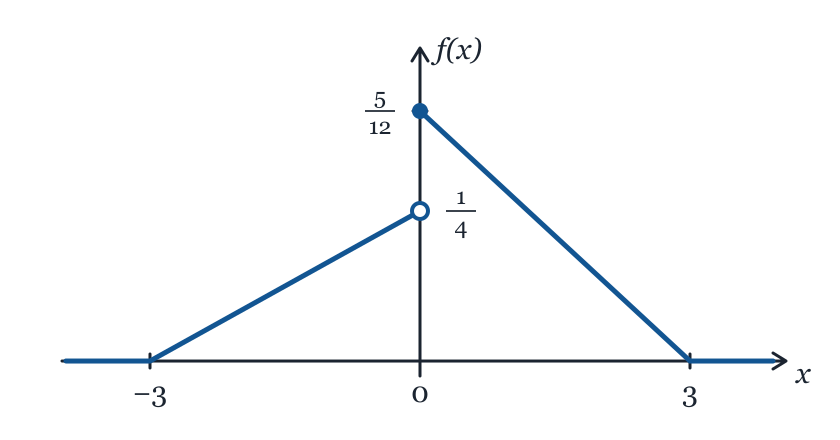
(b)(ii)
解法一
思路
展开
连续分布的众数位于概率密度函数取得最大值的位置。比较图像可见,最高点是右段在 x=0 处的端点。
答题过程
展开
The probability density has its highest value, 5/12, at x=0. Therefore, the mode of X is
0.
(c)
解法一
思路
展开
CDF 是从定义域左端累积到 x 的面积。左段直接从 −3 积到 x;右段可从总概率 1 中减去 x 右侧的小三角形面积,所得形式更紧凑,并自动满足 F(3)=1。
答题过程
展开
For −3⩽x<0,
F(x)==∫−3x121(t+3)dt24(x+3)2.
For 0⩽x⩽3, subtracting the upper-tail triangle from 1 gives
F(x)=1−725(3−x)2.
Hence,
=F(x)⎩⎨⎧0,x<−3,24(x+3)2,−3⩽x<0,1−725(3−x)2,0⩽x⩽3,1,x>3.
解法二
思路
展开
也可从左到右累计积分。左段从 −3 积分到 x;右段需要先加上左半部的概率 3/8,再从 0 积分到 x,不能遗漏这部分累计概率。
答题过程
展开
For −3⩽x<0,
===F(x)∫−3x121(t+3)dt[24t2+4t]−3x24x2+4x+83.
In particular, F(0)=3/8. For 0⩽x⩽3,
===F(x)83+∫0x365(3−t)dt83+365[3t−2t2]0x83+125x−725x2.
These are the expanded forms of the two middle pieces above. For x<−3, F(x)=0; for x>3, F(x)=1.
(d)
解法一
思路
展开
先把条件概率写成尾概率之比。由 (c) 可得 P(X>0)=5/8,因此 P(X>d)=1/4,也就是 F(d)=3/4。由于 d>0,代入 CDF 的右段求解,并根据 0<d<3 选择正确平方根。
答题过程
展开
Since d>0, the event X>d is contained in X>0. Therefore,
===P(X>d∣X>0)P(X>0)P(X>d)1−F(0)1−F(d)52.
From part (c), F(0)=3/8, so
1−F(d)==52(1−83)41.
Thus F(d)=3/4. Using the right-hand part of the CDF,
1−725(3−d)2=(3−d)2=43518.
Since 0<d<3, we require 3−d>0. Hence
d===3−5181.10263…1.10(3 s.f.).
解法二
思路
展开
也可以直接使用面积。条件概率先给出 P(X>d)=1/4;从 d 到 3 的尾部是一个底为 3−d、高为 5(3−d)/36 的三角形,令其面积等于 1/4 即可。
答题过程
展开
As above,
P(X>d)=41.
The region under the density from d to 3 is a triangle. Therefore,
=21(3−d)⋅365(3−d)41(3−d)2=518.
Using 0<d<3 gives
d=≈3−5181.10.
