题目
Problem
Figure 1 shows a sketch of the probability density function f(x) of the random variable X.
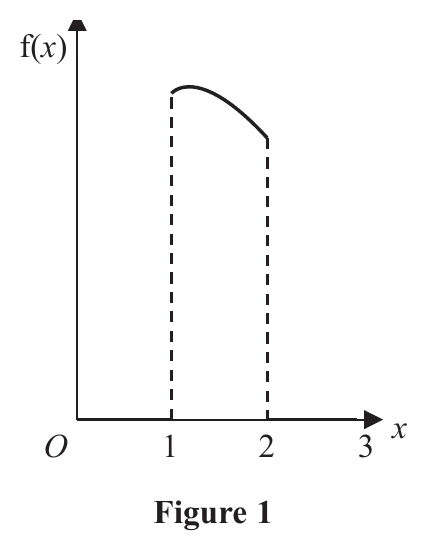
For 1⩽x⩽2, f(x) is represented by a curve with equation
f(x)=k(21x3−3x2+ax+1).
where k and a are constants.
For all other values of x, f(x)=0
(a) Use algebraic integration to show that k(12a−33)=8
(4)
Given that a=5
(b) calculate the mode of X.
(4)
(Total for Question 1 is 8 marks)
题目中文翻译
图 1 给出了随机变量 X 的概率密度函数 f(x) 的草图。
当 1⩽x⩽2 时,f(x) 由曲线表示,其方程为
f(x)=k(21x3−3x2+ax+1).
其中 k 和 a 是常数。
对所有其他 x 值,f(x)=0。
(a) 用代数积分证明 k(12a−33)=8。
(4)
已知 a=5。
(b) 求 X 的众数。
(4)
(第 1 题共 8 分)
解答
(a)
解法一
思路
展开
概率密度函数在整个定义域上的积分为 1。把题目给出的 f(x) 从 1 积到 2,完整代入上下限并整理,即可推出指定关系;这是 Show that 题,因此不能跳过通向目标式的代数步骤。
答题过程
展开
Since f is a probability density function,
∫12f(x)dx=1.
An antiderivative of f(x) is kG(x), where
=G(x)8x4−x3+2ax2+x.
Substituting the two limits gives
G(2)==G(1)==2−8+2a+22a−4,81−1+2a+181+2a.
Therefore,
k[G(2)−G(1)]=1,k(2a−4)−k(81+2a)=1,k(23a−833)=1.
Multiplying by 8 gives
k(12a−33)=8,
as required.
解法二
思路
展开
也可以对密度函数作不定积分,得到累积分布函数加常数。利用 F(1)=0 和 F(2)=1 建立两个方程,再相减消去积分常数。
答题过程
展开
For 1⩽x⩽2, integrating the density gives
F(x)=kG(x)+C,
where
=G(x)8x4−x3+2ax2+x.
Using F(1)=0,
k(81+2a)+C=0.
Using F(2)=1,
k(2a−4)+C=1.
Subtracting the first equation from the second,
k(2a−4)−k(81+2a)=1,k(23a−833)=1.
Multiplying by 8 gives
k(12a−33)=8,
as required.
(b)
解法一
思路
展开
众数是概率密度取得最大值时的 x。先将 a=5 代入并对 f(x) 求导,令导数为 0 求驻点。两个代数根中只有一个落在定义域 1⩽x⩽2;再利用导数在该点前后由正变负确认它是最大值点。
答题过程
展开
From part (a), when a=5,
k(60−33)=8,
so k=8/27>0. Also,
dxdf=k(23x2−6x+5).
At a stationary point,
23x2−6x+5=0.
Hence,
x==36±36−302±36.
Now,
2+36=2.816…
lies outside 1⩽x⩽2, whereas
2−36=1.183…
lies inside the interval. Since f′(x) changes from positive to negative at this point, the mode is
2−36.