题目
Problem
A random variable X X X
f ( x ) = { 1 4 , − 1 2 ⩽ x < 1 2 , 2 x − 3 4 , 1 2 ⩽ x ⩽ k , 0 , otherwise . \begin{aligned}
&\,f(x)=\\
&\,\begin{cases}
\dfrac14,\\
\qquad-\dfrac12\leqslant x<\dfrac12,\\[2mm]
2x-\dfrac34,\\
\qquad\dfrac12\leqslant x\leqslant k,\\[2mm]
0,\quad\text{otherwise}.
\end{cases}
\end{aligned} f ( x ) = ⎩ ⎨ ⎧ 4 1 , − 2 1 ⩽ x < 2 1 , 2 x − 4 3 , 2 1 ⩽ x ⩽ k , 0 , otherwise . where k k k
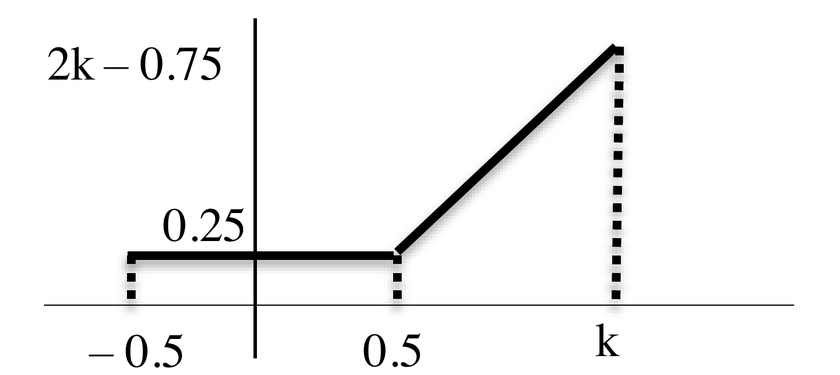
(a) Sketch the graph of f ( x ) f(x) f ( x )
(2)
(b) By forming and solving an equation in k k k k = 1.25 k = 1.25 k = 1.25
(4)
(c) Use calculus to find E ( X ) E(X) E ( X )
(4)
(d) Calculate the interquartile range of X X X
(5)
(Total for Question 2 is 15 marks)
题目中文翻译
随机变量 X X X
f ( x ) = { 1 4 , − 1 2 ⩽ x < 1 2 , 2 x − 3 4 , 1 2 ⩽ x ⩽ k , 0 , otherwise . \begin{aligned}
&\,f(x)=\\
&\,\begin{cases}
\dfrac14,\\
\qquad-\dfrac12\leqslant x<\dfrac12,\\[2mm]
2x-\dfrac34,\\
\qquad\dfrac12\leqslant x\leqslant k,\\[2mm]
0,\quad\text{otherwise}.
\end{cases}
\end{aligned} f ( x ) = ⎩ ⎨ ⎧ 4 1 , − 2 1 ⩽ x < 2 1 , 2 x − 4 3 , 2 1 ⩽ x ⩽ k , 0 , otherwise . 其中 k k k
(a) 画出 f ( x ) f(x) f ( x )
(2)
(b) 通过建立并求解关于 k k k k = 1.25 k = 1.25 k = 1.25
(4)
(c) 使用微积分求 E ( X ) E(X) E ( X )
(4)
(d) 计算 X X X
(5)
(第 2 题共 15 分)
解答
(a)
解法一
思路
展开
在 − 0.5 ⩽ x < 0.5 -0.5\leqslant x<0.5 − 0.5 ⩽ x < 0.5 0.25 0.25 0.25 0.5 ⩽ x ⩽ k 0.5\leqslant x\leqslant k 0.5 ⩽ x ⩽ k x = k x=k x = k 2 k − 0.75 2k-0.75 2 k − 0.75
答题过程
展开
The graph consists of a horizontal segment from ( − 0.5 , 0.25 ) (-0.5,0.25) ( − 0.5 , 0.25 ) ( 0.5 , 0.25 ) (0.5,0.25) ( 0.5 , 0.25 ) ( 0.5 , 0.25 ) (0.5,0.25) ( 0.5 , 0.25 ) ( k , 2 k − 0.75 ) (k,2k-0.75) ( k , 2 k − 0.75 ) f ( x ) = 0 f(x)=0 f ( x ) = 0 [ − 0.5 , k ] [-0.5,k] [ − 0.5 , k ]
(b)
解法一
思路
展开
概率密度函数图像下的总面积为 1。左侧是宽为 1、高为 1 / 4 1/4 1/4 1 / 4 1/4 1/4 2 k − 3 / 4 2k-3/4 2 k − 3/4 k − 1 / 2 k-1/2 k − 1/2 k k k
答题过程
展开
Since the total area under a probability density function is 1,
1 4 + 1 2 ( 1 4 + 2 k − 3 4 ) × ( k − 1 2 ) = 1. \begin{align*}
&\,\frac14\\
&\,\hspace{2pt}+\frac12\Big(\frac14+2k-\frac34\Big)\\
&\,\hspace{8pt}\times\Big(k-\frac12\Big)\\
&\,=1.
\end{align*} 4 1 + 2 1 ( 4 1 + 2 k − 4 3 ) × ( k − 2 1 ) = 1. Therefore,
1 4 + 1 2 ( 2 k − 1 2 ) × ( k − 1 2 ) = 1 , k 2 − 3 4 k + 3 8 = 1 , 8 k 2 − 6 k − 5 = 0 , ( 4 k − 5 ) ( 2 k + 1 ) = 0. \begin{align*}
&\,\frac14+\frac12\Big(2k-\frac12\Big)\\
&\,\hspace{8pt}\times\Big(k-\frac12\Big)\\
&\,=1,\\[2mm]
&\,k^2-\frac34k+\frac38=1,\\
&\,8k^2-6k-5=0,\\
&\,(4k-5)(2k+1)=0.
\end{align*} 4 1 + 2 1 ( 2 k − 2 1 ) × ( k − 2 1 ) = 1 , k 2 − 4 3 k + 8 3 = 1 , 8 k 2 − 6 k − 5 = 0 , ( 4 k − 5 ) ( 2 k + 1 ) = 0. Thus k = 5 / 4 k=5/4 k = 5/4 k = − 1 / 2 k=-1/2 k = − 1/2 k k k
k = 5 4 = 1.25 . \boxed{k=\frac54=1.25}. k = 4 5 = 1.25 .
解法二
思路
展开
也可以直接分段积分,使概率密度在整个定义域上的积分等于 1。积分后会得到与几何面积法等价的二次方程,最后同样排除负根。
答题过程
展开
The total probability is 1, so
∫ − 1 / 2 1 / 2 1 4 d x + ∫ 1 / 2 k ( 2 x − 3 4 ) d x = 1. \begin{align*}
&\,\int_{-1/2}^{1/2}\frac14\,\mathrm{d}x\\
&\,\hspace{2pt}+\int_{1/2}^k\Big(2x-\frac34\Big)\,\mathrm{d}x\\
&\,=1.
\end{align*} ∫ − 1/2 1/2 4 1 d x + ∫ 1/2 k ( 2 x − 4 3 ) d x = 1. Hence,
1 4 + [ x 2 − 3 4 x ] 1 / 2 k = 1 , 1 4 + k 2 − 3 4 k + 1 8 = 1 , k 2 − 3 4 k − 5 8 = 0 , ( 4 k − 5 ) ( 2 k + 1 ) = 0. \begin{align*}
&\,\frac14+\Big[x^2-\frac34x\Big]_{1/2}^k\\
&\,=1,\\[2mm]
&\,\frac14+k^2-\frac34k+\frac18\\
&\,=1,\\[2mm]
&\,k^2-\frac34k-\frac58=0,\\
&\,(4k-5)(2k+1)=0.
\end{align*} 4 1 + [ x 2 − 4 3 x ] 1/2 k = 1 , 4 1 + k 2 − 4 3 k + 8 1 = 1 , k 2 − 4 3 k − 8 5 = 0 , ( 4 k − 5 ) ( 2 k + 1 ) = 0. Since k > 0 k>0 k > 0 k = 5 / 4 = 1.25 k=5/4=1.25 k = 5/4 = 1.25
解法三
思路
展开
把整个面积分成高度为 1 / 4 1/4 1/4 k + 1 / 2 k+1/2 k + 1/2 k − 1 / 2 k-1/2 k − 1/2 2 k − 1 2k-1 2 k − 1
答题过程
展开
The rectangle has area
1 4 ( k + 1 2 ) . \frac14\Big(k+\frac12\Big). 4 1 ( k + 2 1 ) . The height of the triangle is
( 2 k − 3 4 ) − 1 4 = 2 k − 1. \Big(2k-\frac34\Big)-\frac14=2k-1. ( 2 k − 4 3 ) − 4 1 = 2 k − 1. Hence the total area gives
1 4 ( k + 1 2 ) + 1 2 ( 2 k − 1 ) ( k − 1 2 ) = 1. \begin{align*}
&\,\frac14\Big(k+\frac12\Big)\\
&\,\hspace{2pt}+\frac12(2k-1)\Big(k-\frac12\Big)\\
&\,=1.
\end{align*} 4 1 ( k + 2 1 ) + 2 1 ( 2 k − 1 ) ( k − 2 1 ) = 1. Therefore,
k 4 + 1 8 + ( k − 1 2 ) 2 = 1 , k 2 − 3 4 k − 5 8 = 0 , ( 4 k − 5 ) ( 2 k + 1 ) = 0. \begin{align*}
&\,\frac{k}{4}+\frac18+\Big(k-\frac12\Big)^2\\
&\,=1,\\
&\,k^2-\frac34k-\frac58=0,\\
&\,(4k-5)(2k+1)=0.
\end{align*} 4 k + 8 1 + ( k − 2 1 ) 2 = 1 , k 2 − 4 3 k − 8 5 = 0 , ( 4 k − 5 ) ( 2 k + 1 ) = 0. The roots are 5 / 4 5/4 5/4 − 1 / 2 -1/2 − 1/2 k > 0 k>0 k > 0
k = 5 4 = 1.25 . \boxed{k=\frac54=1.25}. k = 4 5 = 1.25 .
(c)
解法一
思路
展开
连续型随机变量的期望为 E ( X ) = ∫ x f ( x ) d x E(X)=\int xf(x)\,\mathrm{d}x E ( X ) = ∫ x f ( x ) d x x / 4 x/4 x /4 k = 5 / 4 k=5/4 k = 5/4
答题过程
展开
Using k = 5 / 4 k=5/4 k = 5/4
E ( X ) = ∫ − 1 / 2 1 / 2 x 4 d x + ∫ 1 / 2 5 / 4 ( 2 x 2 − 3 4 x ) d x . \begin{align*}
&\,E(X)\\
&\,=\int_{-1/2}^{1/2}\frac{x}{4}\,\mathrm{d}x\\
&\,\hspace{2pt}+\int_{1/2}^{5/4}\Big(2x^2\\
&\,\hspace{12pt}-\frac34x\Big)\,\mathrm{d}x.
\end{align*} E ( X ) = ∫ − 1/2 1/2 4 x d x + ∫ 1/2 5/4 ( 2 x 2 − 4 3 x ) d x . The first integral is zero by symmetry. Therefore,
E ( X ) = [ 2 3 x 3 − 3 8 x 2 ] 1 / 2 5 / 4 . \begin{align*}
&\,E(X)\\
&\,=\Big[\frac23x^3-\frac38x^2\Big]_{1/2}^{5/4}.
\end{align*} E ( X ) = [ 3 2 x 3 − 8 3 x 2 ] 1/2 5/4 . The upper endpoint value is
2 3 ( 5 4 ) 3 − 3 8 ( 5 4 ) 2 = 125 96 − 75 128 = 275 384 . \begin{align*}
&\,\frac23\Big(\frac54\Big)^3\\
&\,\hspace{2pt}-\frac38\Big(\frac54\Big)^2\\
&\,=\frac{125}{96}-\frac{75}{128}\\
&\,=\frac{275}{384}.
\end{align*} 3 2 ( 4 5 ) 3 − 8 3 ( 4 5 ) 2 = 96 125 − 128 75 = 384 275 . The lower endpoint value is
2 3 ( 1 2 ) 3 − 3 8 ( 1 2 ) 2 = 1 12 − 3 32 = − 1 96 . \begin{align*}
&\,\frac23\Big(\frac12\Big)^3\\
&\,\hspace{2pt}-\frac38\Big(\frac12\Big)^2\\
&\,=\frac1{12}-\frac3{32}\\
&\,=-\frac1{96}.
\end{align*} 3 2 ( 2 1 ) 3 − 8 3 ( 2 1 ) 2 = 12 1 − 32 3 = − 96 1 . Therefore,
E ( X ) = 275 384 − ( − 1 96 ) = 279 384 = 93 128 . \begin{align*}
&\,E(X)=\frac{275}{384}-\Big(-\frac1{96}\Big)\\
&\,=\frac{279}{384}\\
&\,=\boxed{\frac{93}{128}}.
\end{align*} E ( X ) = 384 275 − ( − 96 1 ) = 384 279 = 128 93 .
(d)
解法一
思路
展开
从 − 1 / 2 -1/2 − 1/2 1 / 2 1/2 1/2 1 / 4 1/4 1/4 Q 1 = 1 / 2 Q_1=1/2 Q 1 = 1/2 1 / 2 1/2 1/2 Q 3 Q_3 Q 3 3 / 4 − 1 / 4 = 1 / 2 3/4-1/4=1/2 3/4 − 1/4 = 1/2 Q 3 − Q 1 Q_3-Q_1 Q 3 − Q 1
答题过程
展开
The area from − 1 / 2 -1/2 − 1/2 1 / 2 1/2 1/2
1 × 1 4 = 1 4 , 1\times\frac14=\frac14, 1 × 4 1 = 4 1 , so
Q 1 = 1 2 . Q_1=\frac12. Q 1 = 2 1 . For the upper quartile,
∫ 1 / 2 Q 3 ( 2 x − 3 4 ) d x = 1 2 . \int_{1/2}^{Q_3}\Big(2x-\frac34\Big)\,\mathrm{d}x
=\frac12. ∫ 1/2 Q 3 ( 2 x − 4 3 ) d x = 2 1 . Thus,
[ x 2 − 3 4 x ] 1 / 2 Q 3 = 1 2 , Q 3 2 − 3 4 Q 3 + 1 8 = 1 2 , Q 3 2 − 3 4 Q 3 − 3 8 = 0. \begin{align*}
&\,\Big[x^2-\frac34x\Big]_{1/2}^{Q_3}=\frac12,\\
&\,Q_3^2-\frac34Q_3+\frac18=\frac12,\\
&\,Q_3^2-\frac34Q_3-\frac38=0.
\end{align*} [ x 2 − 4 3 x ] 1/2 Q 3 = 2 1 , Q 3 2 − 4 3 Q 3 + 8 1 = 2 1 , Q 3 2 − 4 3 Q 3 − 8 3 = 0. Solving,
Q 3 = 3 ± 33 8 . Q_3=\frac{3\pm\sqrt{33}}8. Q 3 = 8 3 ± 33 . Since Q 3 Q_3 Q 3 [ 1 / 2 , 5 / 4 ] [1/2,5/4] [ 1/2 , 5/4 ]
Q 3 = 3 + 33 8 = 1.09307 … \begin{align*}
Q_3=&\,\frac{3+\sqrt{33}}8\\
=&\,1.09307\ldots
\end{align*} Q 3 = = 8 3 + 33 1.09307 … Therefore,
IQR = Q 3 − Q 1 = 3 + 33 8 − 1 2 = 33 − 1 8 = 0.59307 … \begin{align*}
&\,\operatorname{IQR}=Q_3-Q_1\\
&\,=\frac{3+\sqrt{33}}8-\frac12\\
&\,=\frac{\sqrt{33}-1}{8}\\
&\,=0.59307\ldots
\end{align*} IQR = Q 3 − Q 1 = 8 3 + 33 − 2 1 = 8 33 − 1 = 0.59307 … Hence the interquartile range is 0.593 \boxed{0.593} 0.593