题目
Problem
The continuous random variable G has probability density function f(g) given by
f(g)=⎩⎨⎧151(g+3),−1<g⩽2,203,2<g⩽4,0,otherwise.
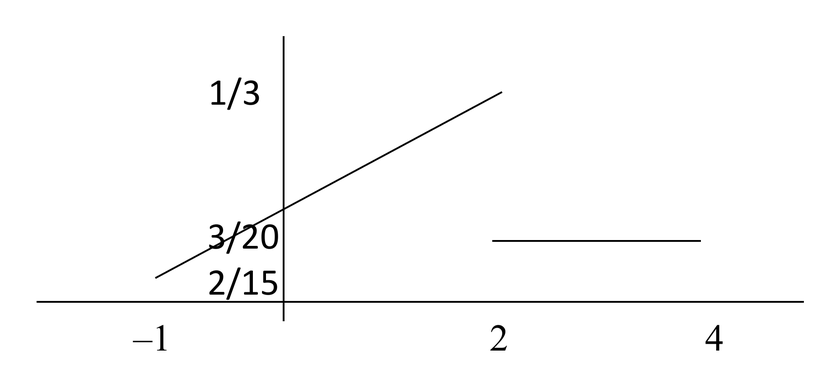
(a) Sketch the graph of f(g)
(2)
(b) Find
P(1⩽2G⩽6∣G⩽2)
(4)
The continuous random variable H is such that E(H)=12 and Var(H)=2.4
(c) Find E(2H2+3G+3)
Show your working clearly.
(Solutions relying on calculator technology are not acceptable.)
(6)
(Total for Question 4 is 12 marks)
题目中文翻译
连续随机变量 G 的概率密度函数 f(g) 为
f(g)=⎩⎨⎧151(g+3),−1<g⩽2,203,2<g⩽4,0,其他情况.
(a) 画出 f(g) 的图像。
(2)
(b) 求
P(1⩽2G⩽6∣G⩽2).
(4)
连续随机变量 H 满足 E(H)=12 且 Var(H)=2.4。
(c) 求 E(2H2+3G+3)。
清楚地展示你的计算过程。
(依赖计算器技术的解答不可接受。)
(6)
(第 4 题共 12 分)
解答
(a)
解法一
思路
展开
在 −1<g⩽2 上,密度是斜率为 1/15 的上升直线,端点高度分别趋近 2/15 和等于 1/3;在 2<g⩽4 上,密度是高度 3/20 的水平线。注意 g=2 处有向下跳跃,两段不能连接,区间外密度为 0,并标清横轴端点及关键高度。
答题过程
展开
For −1<g⩽2, draw the increasing line segment from the open endpoint (−1,2/15) to the closed endpoint (2,1/3).
For 2<g⩽4, draw the horizontal segment f(g)=3/20, open at g=2 and closed at g=4. Also show f(g)=0 outside these intervals.
(b)
解法一
思路
展开
先把 1⩽2G⩽6 化成 0.5⩽G⩽3。再结合条件 G⩽2,分子事件缩成 0.5⩽G⩽2。分别对密度积分求分子、分母,再套用条件概率公式。
答题过程
展开
The condition 1⩽2G⩽6 is equivalent to
0.5⩽G⩽3.
Also,
P(G⩽2)=∫−1215g+3dg=[30g2+5g]−12=(304+52)−(301−51)=3016+305=107.
Under the condition G⩽2, the required numerator is
P(0.5⩽G⩽2)=∫0.5215g+3dg=[30g2+5g]0.52=158−(1201+101)=12064−12013=4017.
Therefore,
P(1⩽2G⩽6∣G⩽2)=7/1017/40=2817.
解法二
思路
展开
在条件 G⩽2 下,目标事件的补集是 G<0.5。先求 P(G<0.5),除以 P(G⩽2) 得到条件补事件概率,再从 1 中减去。
答题过程
展开
From Method 1,
P(G⩽2)=107.
Also,
P(G<0.5)=∫−10.515g+3dg=[30g2+5g]−10.5=(1201+101)−(301−51)=12013+12020=4011.
Hence
P(1⩽2G⩽6∣G⩽2)=1−7/1011/40=2817.
解法三
思路
展开
在 G⩽2 的范围内,密度曲线下的面积是梯形。分别用梯形面积公式求整个区间与目标区间的面积,再取比值。分母也可以由总面积 1 减去右侧矩形面积得到。
答题过程
展开
The first linear segment has height 2/15 at its left end. Also,
f(0.5)=f(2)=150.5+3=307,152+3=31.
Using trapezium areas,
P(G⩽2)=21⋅3(152+31)=23⋅157=107.
Equivalently, subtracting the right-hand rectangle gives
P(G⩽2)==1−2⋅203107.
Also,
P(0.5⩽G⩽2)=21⋅1.5(307+31)=43⋅3017=4017.
Therefore,
P(1⩽2G⩽6∣G⩽2)=7/1017/40=2817.
(c)
解法一
思路
展开
先利用方差公式,由已知均值与方差求出 E(H2)。再按 G 的分段密度积分求 E(G)。最后使用期望的线性性质;这里不需要假设 H 与 G 独立。
答题过程
展开
Using
Var(H)=E(H2)−[E(H)]2,
we have
E(H2)=2.4+122=146.4.
Also,
E(G)=∫−12g(15g+3)dg+∫24g(203)dg=151[3g3+23g2]−12+403[g2]24.
The first contribution is
151[3g3+23g2]−12=151[(38+6)−(−31+23)]=151(326−67)=151⋅645=0.5.
The second contribution is
403(42−22)==403(16−4)0.9.
Thus
E(G)=0.5+0.9=1.4.
By linearity of expectation,
E(2H2+3G+3)=2E(H2)+3E(G)+3=2(146.4)+3(1.4)+3=300.
