题目
Problem
The continuous random variable X has probability density function given by
f(x)=
⎩⎨⎧ax,0⩽x⩽4,bx+c,4<x⩽8,0,otherwise.
where a, b and c are constants.
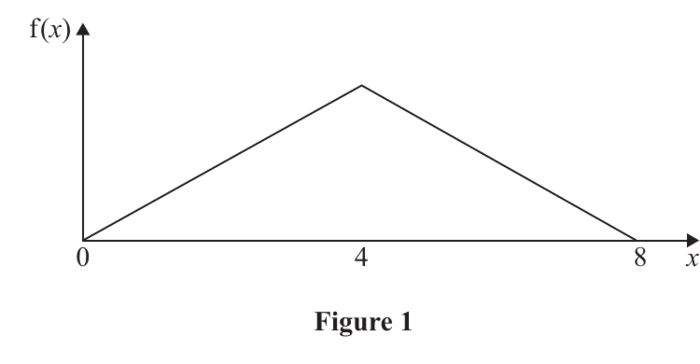
Figure 1 shows the graph of the probability density function f(x).
The graph consists of two straight line segments of equal length joined at the point where x=4.
(a) Show that a=161
(1)
(b) Hence find
(i) the value of b
(ii) the value of c
(3)
(c) Using algebraic integration, show that Var(X)=38
(6)
(d) Find, to 2 decimal places, the lower quartile and the upper quartile of X
(3)
A statistician claims that
P(−σ<X−μ<σ)>0.5
where μ and σ are the mean and standard deviation of X.
(e) Show that the statistician’s claim is correct.
(2)
(Total for Question 7 is 15 marks)
题目中文翻译
连续随机变量 X 的概率密度函数为
f(x)=
⎩⎨⎧ax,0⩽x⩽4,bx+c,4<x⩽8,0,其他情况.
其中 a、b 和 c 为常数。
图 1 显示了概率密度函数 f(x) 的图像。
该图像由两段等长的直线段组成,在 x=4 处连接。
(a) 证明 a=161
(1)
(b) 由此求
(i) b 的值
(ii) c 的值
(3)
(c) 使用代数积分,证明 Var(X)=38
(6)
(d) 求 X 的下四分位数和上四分位数(精确到 2 位小数)。
(3)
一位统计学家声称
P(−σ<X−μ<σ)>0.5
其中 μ 和 σ 为 X 的均值和标准差。
(e) 证明统计学家的声称是正确的。
(2)
(第 7 题共 15 分)
解答
(a)
解法一
思路
展开
概率密度图下的总面积为 1。图像是底为 8、高为 4a 的三角形,因此直接用三角形面积公式即可求出 a。
答题过程
展开
The total area under the probability density function is 1. Therefore,
21(8)(4a)=16a=11.
Hence,
a=161.
解法二
思路
展开
图像关于 x=4 对称,所以左半部分的面积为 1/2。把 ax 从 0 积分到 4,也可直接求出 a。
答题过程
展开
By symmetry, the area under the left-hand part of the graph is 1/2. Thus
∫04axdx=[2ax2]04=8a=212121.
Therefore,
a=161.
(b)(i)
解法一
思路
展开
两条线段等长并在 x=4 连接,图像关于 x=4 对称。右半段的斜率与左半段大小相等、符号相反;承接 (a) 的 a=1/16 即可得到 b。
答题过程
展开
By symmetry, the gradient of the right-hand line segment is the negative of the gradient of the left-hand segment. Hence
b=−a=−161.
(b)(ii)
解法一
思路
展开
右半段在点 (8,0) 处与横轴相交。把 x=8、f(8)=0 及 (b)(i) 的 b 代入直线 f(x)=bx+c,即可求出截距 c。
答题过程
展开
The right-hand line passes through (8,0), so
0=c=−161(8)+c21.
Equivalently, the line passes through (4,1/4), so
41=c=−161(4)+c,41+41=21.
(c)
解法一
思路
展开
概率密度图关于 x=4 对称,因此均值为 E(X)=4。再分段积分计算二阶矩,最后使用方差公式:
Var(X)=E(X2)−[E(X)]2.
答题过程
展开
By symmetry,
E(X)=4.
Using the values found in parts (a) and (b),
E(X2)=∫04x2(16x)dx+∫48x2(−16x+21)dx=[64x4]04+[−64x4+6x3]48=6444−04+(−6484+683)−(−6444+643)=4+(−64+3256)−(−4+332)=4+364−320=356.
Therefore,
Var(X)=E(X2)−[E(X)]2=356−42=356−48=38.
(d)
解法一
思路
展开
下四分位数 Q1 位于左半段,并满足 P(X≤Q1)=0.25,所以把左半段密度从 0 积分到 Q1。图像关于 x=4 对称,上四分位数可由 Q3=8−Q1 得到。
答题过程
展开
For the lower quartile Q1,
∫0Q116xdx=32Q12=Q12=0.25418.
Since Q1>0,
Q1=8=2.828…
The distribution is symmetric about x=4, so
Q3===8−Q18−85.171….
Therefore, to 2 decimal places,
Q1=Q3=2.83,5.17.
解法二
思路
展开
下四分位数左侧是一个三角形,底为 Q1,高为 Q1/16,面积为 1/4。用三角形面积公式求 Q1,再利用关于 x=4 的对称性求 Q3。
答题过程
展开
The area to the left of Q1 is a triangle with base Q1 and height Q1/16. Hence
21Q1(16Q1)=Q12=41,8.
Since 0<Q1<4,
Q1=8=2.828….
By symmetry about x=4,
Q3===8−Q18−85.171….
Therefore, to 2 decimal places,
Q1=Q3=2.83,5.17.
(e)
解法一
思路
展开
先把声称中的事件改写为 μ−σ<X<μ+σ,并用 (c) 的均值与方差求两个边界。再与 (d) 的上下四分位数比较:四分位区间内恰有 50% 的概率,而均值上下一个标准差的区间严格包含四分位区间,因此其概率严格大于 0.5。
答题过程
展开
From part (c),
μ=σ==4,381.63299….
Hence
μ−σ=μ+σ=2.367…5.632…
From part (d),
2.367…<Q1=2.828…
and
Q3=5.171…<5.632….
The interval (Q1,Q3) contains probability 0.5 and is strictly contained in (μ−σ,μ+σ). Therefore,
P(−σ<X−μ<σ)>0.5,
so the statistician’s claim is correct.
解法二
思路
展开
也可直接计算均值上下一个标准差之间的概率。利用图像关于 4 对称,只需求左端点以下的概率,再从 1 中减去两侧相等的尾部概率。
答题过程
展开
Let
L=4−38=2.367…
By symmetry, the two tail probabilities outside (μ−σ,μ+σ) are equal. Since L<4,
F(L)===∫0L16xdx[32x2]0L32L2.
Therefore,
P(−σ<X−μ<σ)=1−2F(L)=1−16L2=0.6498…>0.5.
Thus the statistician’s claim is correct.