题目
Problem
In this question you must show all stages of your working.
Solutions relying entirely on calculator technology are not acceptable.
A farmer grows watermelons on a farm. The weights, in kilograms, of the watermelons are modelled by the random variable W W W
f ( w ) = { 1 9 ( 6 − w ) ( w − 2 ) , 2 ≤ w ≤ 5 , 0 , otherwise . \begin{align*}
&\,f(w)=\\[4mm]
&\,\begin{cases}
\begin{aligned}\dfrac{1}{9}(6-w)(w-2),\\[-2pt]2\leq w\leq5,\end{aligned}\\[6pt]
\begin{aligned}0,\\[-2pt]\text{otherwise}.\end{aligned}
\end{cases}
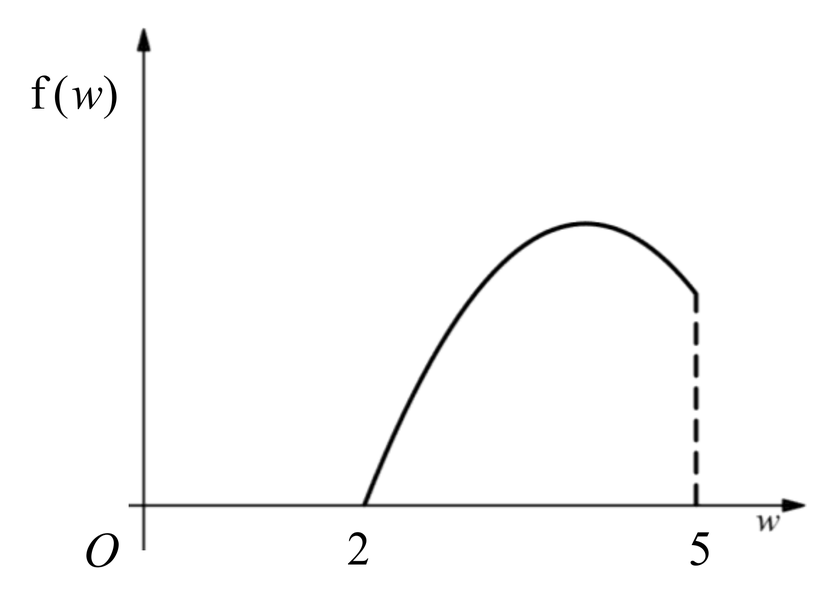
\end{align*} f ( w ) = ⎩ ⎨ ⎧ 9 1 ( 6 − w ) ( w − 2 ) , 2 ≤ w ≤ 5 , 0 , otherwise . (a) Sketch the graph of f ( w ) f(w) f ( w )
(2)
(b) State the mode of W W W
(1)
(c) Find the mean weight of these watermelons.
(4)
Given that E ( W 2 ) = 73 5 E(W^2)=\dfrac{73}{5} E ( W 2 ) = 5 73
(d) find the standard deviation of the weights of these watermelons, giving the answer to 3 significant figures.
(2)
(e) Show that the median lies between w = 3.7 w=3.7 w = 3.7 w = 3.8 w=3.8 w = 3.8
(5)
The farmer inspects the watermelons to check whether or not they are spoiled.
The number of spoiled watermelons found by the farmer in an area of 150 m 2 150\text{ m}^2 150 m 2
The farmer randomly selects an area of 900 m 2 900\text{ m}^2 900 m 2
(f) Use a normal approximation to find the probability that the farmer finds fewer than 20 spoiled watermelons.
(5)
(Total for Question 6 is 19 marks)
题目中文翻译
本题中,你必须展示计算过程的所有步骤。
完全依赖计算器技术的解答不可接受。
一名农民在农场种植西瓜。西瓜的重量(单位:千克)由随机变量 W W W
f ( w ) = { 1 9 ( 6 − w ) ( w − 2 ) , 2 ≤ w ≤ 5 , 0 , 其他情况 . \begin{align*}
&\,f(w)=\\[4mm]
&\,\begin{cases}
\begin{aligned}\dfrac{1}{9}(6-w)(w-2),\\[-2pt]2\leq w\leq5,\end{aligned}\\[6pt]
\begin{aligned}0,\\[-2pt]\text{其他情况}.\end{aligned}
\end{cases}
\end{align*} f ( w ) = ⎩ ⎨ ⎧ 9 1 ( 6 − w ) ( w − 2 ) , 2 ≤ w ≤ 5 , 0 , 其他情况 . (a) 画出 f ( w ) f(w) f ( w )
(2)
(b) 写出 W W W
(1)
(c) 求这些西瓜的平均重量。
(4)
已知 E ( W 2 ) = 73 5 E(W^2)=\dfrac{73}{5} E ( W 2 ) = 5 73
(d) 求这些西瓜重量的标准差,答案保留 3 位有效数字。
(2)
(e) 证明中位数位于 w = 3.7 w=3.7 w = 3.7 w = 3.8 w=3.8 w = 3.8
(5)
农民检查西瓜是否变质。在农场面积为 150 m 2 150\text{ m}^2 150 m 2
农民从农场随机选取面积为 900 m 2 900\text{ m}^2 900 m 2
(f) 使用正态近似,求农民发现少于 20 个变质西瓜的概率。
(5)
(第 6 题共 19 分)
解答
(a)
解法一
思路
展开
先由两个因式确定零点,再看二次项系数判断抛物线开口方向。密度只在给定区间内存在,区间外为零。
答题过程
展开
The graph is a downward-opening quadratic with roots w = 2 w=2 w = 2 w = 6 w=6 w = 6
On the required interval, it starts at ( 2 , 0 ) (2,0) ( 2 , 0 ) w = 4 w=4 w = 4
f ( 5 ) = ( 6 − 5 ) ( 5 − 2 ) 9 = 1 3 . f(5)=\frac{(6-5)(5-2)}9=\frac13. f ( 5 ) = 9 ( 6 − 5 ) ( 5 − 2 ) = 3 1 . Also, f ( w ) = 0 f(w)=0 f ( w ) = 0 w < 2 w<2 w < 2 w > 5 w>5 w > 5
(b)
解法一
思路
展开
密度曲线最高点的横坐标就是众数。由 (a) 的对称轴可直接读出。
答题过程
展开
The maximum of the quadratic occurs at w = 4 w=4 w = 4
Therefore,
Mode of W = 4 kg . \boxed{\text{Mode of }W=4\text{ kg}}. Mode of W = 4 kg .
(c)
解法一
思路
展开
连续型随机变量的均值为 ∫ w f ( w ) d w \int wf(w)\,\mathrm{d}w ∫ w f ( w ) d w [ 2 , 5 ] [2,5] [ 2 , 5 ]
答题过程
展开
Let
g ( w ) = w ( 6 − w ) ( w − 2 ) = − w 3 + 8 w 2 − 12 w . \begin{align*}
g(w)=&\,w(6-w)(w-2)\\[4mm]
=&\,-w^3+8w^2-12w.
\end{align*} g ( w ) = = w ( 6 − w ) ( w − 2 ) − w 3 + 8 w 2 − 12 w . Then
E ( W ) = 1 9 ∫ 2 5 g ( w ) d w . E(W)=\frac19\int_2^5g(w)\,\mathrm{d}w. E ( W ) = 9 1 ∫ 2 5 g ( w ) d w . An antiderivative of the expanded integrand is
H ( w ) = − w 4 4 + 8 w 3 3 − 6 w 2 . \begin{align*}
&\,H(w)\\[4mm]
=&\,-\frac{w^4}{4}+\frac{8w^3}{3}-6w^2.
\end{align*} = H ( w ) − 4 w 4 + 3 8 w 3 − 6 w 2 . At the limits,
H ( 5 ) = − 625 4 + 1000 3 − 150 = 325 12 , H ( 2 ) = − 4 + 64 3 − 24 = − 20 3 . \begin{align*}
&\,H(5)\\[4mm]
=&\,-\frac{625}{4}+\frac{1000}{3}-150\\[4mm]
=&\,\frac{325}{12},\\[4mm]
&\,H(2)\\[4mm]
=&\,-4+\frac{64}{3}-24\\[4mm]
=&\,-\frac{20}{3}.
\end{align*} = = = = H ( 5 ) − 4 625 + 3 1000 − 150 12 325 , H ( 2 ) − 4 + 3 64 − 24 − 3 20 . Therefore,
E ( W ) = 1 9 [ H ( w ) ] 2 5 = 1 9 ( 325 12 + 20 3 ) = 15 4 = 3.75 kg . \begin{align*}
E(W)=&\,\frac19\big[H(w)\big]_2^5\\[4mm]
=&\,\frac19\Big(\frac{325}{12}+\frac{20}{3}\Big)\\[4mm]
=&\,\frac{15}{4}=\boxed{3.75\text{ kg}}.
\end{align*} E ( W ) = = = 9 1 [ H ( w ) ] 2 5 9 1 ( 12 325 + 3 20 ) 4 15 = 3.75 kg .
(d)
解法一
思路
展开
使用方差恒等式
Var ( W ) = E ( W 2 ) − [ E ( W ) ] 2 , \begin{align*}
&\,\operatorname{Var}(W)\\[4mm]
=&\,E(W^2)-[E(W)]^2,
\end{align*} = Var ( W ) E ( W 2 ) − [ E ( W ) ] 2 , 再从方差开平方得到标准差。
答题过程
展开
Var ( W ) = 73 5 − ( 15 4 ) 2 = 43 80 . \begin{align*}
\operatorname{Var}(W)
=&\,\frac{73}{5}-\Big(\frac{15}{4}\Big)^2\\[4mm]
=&\,\frac{43}{80}.
\end{align*} Var ( W ) = = 5 73 − ( 4 15 ) 2 80 43 . Hence
sd ( W ) = 43 80 = 0.73314 … ≈ 0.733 kg . \begin{align*}
\operatorname{sd}(W)
=&\,\sqrt{\frac{43}{80}}\\[4mm]
=&\,0.73314\ldots\\[4mm]
\approx&\,\boxed{0.733\text{ kg}}.
\end{align*} sd ( W ) = = ≈ 80 43 0.73314 … 0.733 kg . The answer is given to 3 significant figures.
(e)
解法一
思路
展开
中位数 m m m P ( W ≤ m ) = 0.5 P(W\leq m)=0.5 P ( W ≤ m ) = 0.5
答题过程
展开
For 2 ≤ w ≤ 5 2\leq w\leq5 2 ≤ w ≤ 5
F ( w ) = 1 9 ∫ 2 w 9 f ( t ) d t . F(w)=\frac19\int_2^w9f(t)\,\mathrm{d}t. F ( w ) = 9 1 ∫ 2 w 9 f ( t ) d t . Here 9 f ( t ) = − t 2 + 8 t − 12 9f(t)=-t^2+8t-12 9 f ( t ) = − t 2 + 8 t − 12
h ( t ) = − t 3 3 + 4 t 2 − 12 t . h(t)=-\frac{t^3}{3}+4t^2-12t. h ( t ) = − 3 t 3 + 4 t 2 − 12 t . At the lower limit,
h ( 2 ) = − 8 3 + 16 − 24 = − 32 3 . \begin{align*}
h(2)=&\,-\frac83+16-24\\[4mm]
=&\,-\frac{32}{3}.
\end{align*} h ( 2 ) = = − 3 8 + 16 − 24 − 3 32 . Hence
F ( w ) = 1 9 ( h ( w ) + 32 3 ) . F(w)=\frac19\Big(h(w)+\frac{32}{3}\Big). F ( w ) = 9 1 ( h ( w ) + 3 32 ) . Substituting each boundary gives
F ( 3.7 ) = 1 9 ( − 3.7 3 3 + 4 ( 3.7 ) 2 − 12 ( 3.7 ) + 32 3 ) = 0.460 … < 0.5 , F ( 3.8 ) = 1 9 ( − 3.8 3 3 + 4 ( 3.8 ) 2 − 12 ( 3.8 ) + 32 3 ) = 0.504 … > 0.5. \begin{align*}
&\,F(3.7)\\[4mm]
=&\,\frac19\Big(-\frac{3.7^3}{3}+4(3.7)^2\\[4mm]
&\,\hspace{2pt}-12(3.7)+\frac{32}{3}\Big)\\[4mm]
=&\,0.460\ldots<0.5,\\[4mm]
&\,F(3.8)\\[4mm]
=&\,\frac19\Big(-\frac{3.8^3}{3}+4(3.8)^2\\[4mm]
&\,\hspace{2pt}-12(3.8)+\frac{32}{3}\Big)\\[4mm]
=&\,0.504\ldots>0.5.
\end{align*} = = = = F ( 3.7 ) 9 1 ( − 3 3. 7 3 + 4 ( 3.7 ) 2 − 12 ( 3.7 ) + 3 32 ) 0.460 … < 0.5 , F ( 3.8 ) 9 1 ( − 3 3. 8 3 + 4 ( 3.8 ) 2 − 12 ( 3.8 ) + 3 32 ) 0.504 … > 0.5. Since the cumulative probability passes through 0.5 0.5 0.5
3.7 < median < 3.8 . \boxed{3.7<\text{median}<3.8}. 3.7 < median < 3.8 .
解法二
思路
展开
也可以直接令累计概率等于 0.5 0.5 0.5
答题过程
展开
Let the median be m m m
∫ 2 m f ( w ) d w = 1 2 , 9 f ( w ) = − w 2 + 8 w − 12. \begin{align*}
&\,\int_2^mf(w)\,\mathrm{d}w=\frac12,\\[4mm]
&\,9f(w)=-w^2+8w-12.
\end{align*} ∫ 2 m f ( w ) d w = 2 1 , 9 f ( w ) = − w 2 + 8 w − 12. Integrating and substituting both limits gives
1 9 ( − m 3 3 + 4 m 2 − 12 m + 32 3 ) = 1 2 , − 2 m 3 + 24 m 2 − 72 m + 64 = 27 , 2 m 3 − 24 m 2 + 72 m − 37 = 0. \begin{align*}
&\,\frac19\Big(-\frac{m^3}{3}+4m^2-12m\\[4mm]
&\,\hspace{2pt}+\frac{32}{3}\Big)=\frac12,\\[4mm]
&\,-2m^3+24m^2-72m\\[4mm]
&\,\hspace{2pt}+64=27,\\[4mm]
&\,2m^3-24m^2+72m\\[4mm]
&\,\hspace{2pt}-37=0.
\end{align*} 9 1 ( − 3 m 3 + 4 m 2 − 12 m + 3 32 ) = 2 1 , − 2 m 3 + 24 m 2 − 72 m + 64 = 27 , 2 m 3 − 24 m 2 + 72 m − 37 = 0. The roots are approximately 0.65 0.65 0.65 3.79 3.79 3.79 7.6 7.6 7.6 3.79 … 3.79\ldots 3.79 … [ 2 , 5 ] [2,5] [ 2 , 5 ]
m ≈ 3.79 , \boxed{m\approx3.79}, m ≈ 3.79 , which again shows that 3.7 < m < 3.8 3.7<m<3.8 3.7 < m < 3.8
(f)
解法一
思路
展开
面积从 150 m 2 150\text{ m}^2 150 m 2 900 m 2 900\text{ m}^2 900 m 2 19.5 19.5 19.5
答题过程
展开
Let X X X
X ∼ Po ( 30 ) . X\sim\operatorname{Po}(30). X ∼ Po ( 30 ) . Using the normal approximation,
V ∼ N ( 30 , 30 ) . V\sim\operatorname{N}(30,30). V ∼ N ( 30 , 30 ) . Let Z ∼ N ( 0 , 1 ) Z\sim\operatorname{N}(0,1) Z ∼ N ( 0 , 1 )
P ( X < 20 ) ≈ P ( V < 19.5 ) = P ( Z < 19.5 − 30 30 ) = P ( Z < − 1.917 … ) ≈ 0.0276 . \begin{align*}
&\,P(X<20)\\[4mm]
\approx&\,P(V<19.5)\\[4mm]
=&\,P\Big(Z<\frac{19.5-30}{\sqrt{30}}\Big)\\[4mm]
=&\,P(Z<-1.917\ldots)\\[4mm]
\approx&\,\boxed{0.0276}.
\end{align*} ≈ = = ≈ P ( X < 20 ) P ( V < 19.5 ) P ( Z < 30 19.5 − 30 ) P ( Z < − 1.917 … ) 0.0276 .